
Showing posts with label Matthias Wandel. Show all posts
Showing posts with label Matthias Wandel. Show all posts
Sunday, January 28, 2018
Just screw it
 |
| Even Nancy Reagan knew better than to use pocket screws to make “heirloom” or “fine furniture” projects. |
As I alluded to last month, I’ve been in sort of a funk lately and have lacked the motivation to do pretty much everything.
I’d blame it on the recent frigid weather that’s blanketed the Northeast, but even if temperatures had
been above single digits, I still don’t think I’d be doing much more than I’m doing now. Curling up under the covers and watching YouTube woodworking videos.
Aside from being entertaining, they’re usually pretty informative and I usually pick up a tip or two to try out in my own projects when the weather gets warmer.
Not this year, though. Lately I’ve been growling at screen and yelling at my woodworking buddies like an old man shaking his fist at the neighborhood kids telling them to stay off his lawn.
So what have these woodworkers and makers done to bring out my inner curmudgeon?
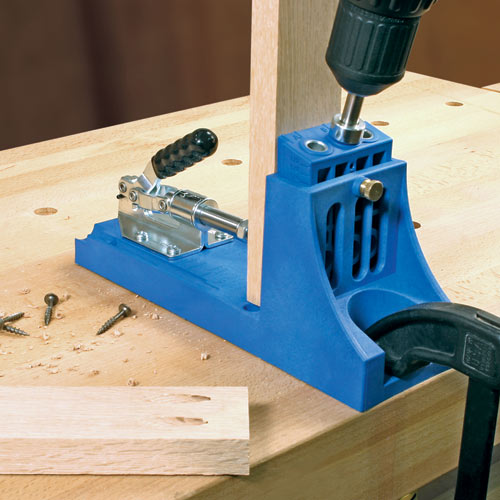 |
I have the Kreg pocket screw jig and have used it on many a project.
But it should not be used to replace other joinery methods on certain
projects because while it is quicker to make, it's a weaker joint. |
Pocket Screws.
I’m not against their use. Like any other tool or technique, they have their time and place. I've even used them from time-to-time. So why have they now raised my ire?
Because many of the makers I follow online are using them way too much as shortcuts.
Look, I get it.
For some of them, building projects and putting out weekly videos is how they earn their
livings. Time is, after all, money and using pocket screws to assemble a project certainly speeds things up.
But I still think it’s a cheat.
Pocket hole joinery, as it is called, is a pretty weak joint. Just ask Matthias Wandel, an engineer by
training and a genius woodworker who makes his own power tools often out of scrap wood and other
“found” objects. He’s famously railed against their use, and even produced a video or two comparing
their strength against other joinery types.
Even the simpler dado and rabbet joint, which are essentially notches or channels cut into the center or edge of a board, are stronger than one put together with pocket screws. They also don’t really take that much longer to make, hence my ire.
I’m not saying they should never be used for a project. They are fine for things that need to be slapped together fast, like storage shelves, boxes or bins for a garage, shed or basement. But for those
“heirloom” or “fine furniture” projects they should be avoided.
Typically, you are going to put a lot of time and effort into making these pieces special, so why cut
corners, especially if it won’t save you that much time and it weakens the strength of the project?
Yes, pocket hole screws can be a good option for things like face and dust frames which are not
structural, and yes they are useful for those with limited tools. But they should never be used as a “goto” joint, and if they are used it should always be explained there is a better way to do that joint.
Like it or not, YouTube makers are educators, and they should be teaching those who want to take up
the craft the proper way of doing things, instead of just basically saying “Screw it!”

Wednesday, July 22, 2015
Making it look easy, isn’t easy
 |
| Putting together a good how-to can be just as frustrating as putting together a jigsaw puzzle. |
 |
| “Woodworking for Mere Mortals” |
These often well produced, always entertaining and informative how-to videos which show various projects’ progressions from concept through completion, was the inspiration for last month’s “Giving Old Tech New Life” post.
 |
| Matthias Wandel |
I was confident I could knock the whole thing out in an hour or so.
Boy, was I wrong.
Unlike taking a series of screen shots and writing a captions for them describing what a user needs to click on to proceed to the next step, documenting a build as “simple” as the clock in last month’s blog was a hell of a lot more complex than I’d ever imaged.
 |
| “The Wood Whisperer” |
I never realized the way I work in my shop is drastically different from the way I do things at work.
Almost by definition, working with computers requires approaching things in a logical, orderly fashion; following an exact series of steps in a sequential manner until the task at hand is done. At work, this is exactly how I do things.
But in my shop, I just wing it. I rarely if ever draw any real plans, make a cut list or plot out the order of the build. At most, I have a few crude sketches with dimensions scrawled on them and an idea that I’ve been turning over in my head for a few weeks.
I am well aware that this isn’t the most efficient use of my rather limited time in my shop. I know that if I actually spent some time to create a set of detailed plans in Sketch-Up or even Quark Xpress, I’d be able to avoid the slowdowns that always seem to crop up because I hadn’t foreseen some problem or another when I had “built” the project in my head.
 |
| “Think Woodworks” |
Yet even if I had made detailed plans and followed them to the letter, the clock build still would have taken me twice as long to complete as would have if I wasn’t documenting it. After every step, I had to remember to stop and try to get clear, in-focus pictures that showed what I was doing.
Once that was done I thought I was home-free. All that remained was to write a short introduction and 20 or so captions for the photos, then post it on the blog. I was sure I could accomplish all that in an hour.
Yeah, right…
 |
| Frank Makes” |
“Cool!” I thought. “Everything’s going to plan for once.”
I should have realized right then and there that things wouldn’t be quite that easy.
Instead of the five minutes I’d thought it take me to upload the photos, cut and paste some text and write some simple HTML to get everything looking the way I wanted, it took me over three bloody hours!
I freely admit I’m no IT genius. I’m a generalist who has a very broad understanding of all the various specialties that make up the Information Technology field, and while none of that knowledge runs really deep, I sure as hell know how to create a basic HTML table!!
 |
| Jimmy Diresta |
My coding skills won’t win any awards, and I know the use of tables to format a webpage went out of style with Netscape Navigator back in the late ’90s, but hey, it’s a quick, down and dirty way to do it.
So why the hell Blogspot constantly kept rewriting my code and completely screwing it up is beyond me!
Hey Google. Leave my #%$@! HTML code alone, damn it!
I could have built my own web server from spare parts, bought and registered my own domain and created an entire web site from scratch using only Notepad in the time it took me to get Blogspot to format my last post correctly! (Yes, I know there are third party slideshow plug-ins I could have used, but I mistakenly thought it would be quicker to build my own table rather than learning how to use one of those.)
 |
| April “Wilkerdos” Wilkerson |
So to all of them I say a hearty thank you for keeping me inspired, making me want to get back into my shop and for helping me to wind down at the end of each week.
And if you’ve never check out any of their channels before, please do. Maybe they’ll inspire you too.
Subscribe to:
Posts (Atom)