
Showing posts with label history repeating itself. Show all posts
Showing posts with label history repeating itself. Show all posts
Tuesday, June 30, 2020
Am I the alien outsider?
 |
Even Mr. Spock, Lt. Cmdr. Data, Jake Scully and John Crichton would be hard pressed to understand what's going on today in our world.
|
There is a long history in science fiction and fantasy of using an alien or other outsider to comment on society.
Sometimes, as in the case of “Star Trek” and its various spinoffs, it is an alien or android living among humans trying to figure us out.
Other times the trope is reversed, as is the case in “Avatar” and “Farscape,” where a sole human is stuck living among aliens and is forced to see the foibles of humanity through the eyes of the aliens he or she is living with.
In my long-in-progress sci-fi novel, I use both versions of this trope: first the alien trying to figure out and fit in to human society while stuck on Earth in the late 1980s, and later in the story, his human companion trying to adjust to his society after they are whisked far across the galaxy.
While it’s still not quite finished, I always felt it was far easier to write from the human’s point of view rather than the other way around. After all, I’m a human ( just ignore that green blood, ok? ) and I grew up on this planet so humanity’s norms seem…. well … normal to me.
It doesn’t generally occur to me to question why we humans do things the way we do, until I see someone or some group act so outside those norms, that it starts me questioning things I’ve always taken for granted.
And lately this has been the case.
Now I feel more akin to my alien character who got dropped off on a strange, new world and can’t always make sense of the things he sees or figure out what all these crazy people who sort of look like him are thinking or doing.
Over the past few years I’ve watched friends and even family members turn into people I barely recognize. It’s almost as if they were being replaced by pod-people.
I feel just as alone, frightened and doubting of my own sanity as Dr. Miles Bennell at the end of “Invasion of the Body Snatchers.” I feel like I’m standing alone on that highway screaming to everyone that that aliens are coming and no one believes me and think I’m nuts.
And I have to admit, I am beginning to wonder if I am going crazy. How is it I can see what everyone else seems to be oblivious to?
Sometimes I think maybe it’s me who is being oblivious.
And that’s possible. I’ve missed so many subtle hints from Mrs. Bluescream that she’s taken to leaving catalogues around the house shortly before her birthday, the holidays or our anniversary with the items she wants circled in red.
So now I’m wondering if I somehow missed a message everyone else got, which, if I had understood it, would have me feeling and acting the same way they do?
After all, my friends and I all grew up together in the same place and under the same circumstances. We all lived in a fairly affluent town, came from the same middle-class, suburban background, were raised by parents who seemed like they could have been interchangeable, share the same educational level and for the most part are all white-collar professionals. So why wouldn’t we all interpret a message the same way?
Growing up we were the “nerds” who all the other kids picked on for liking sci-fi/fantasy, playing Dungeons and Dragons and being into computers and video games. (Who’s laughing now you jocks and popular kids? Sure I’ll fix your computer….for a price!) If you’ve ever watched any ’80s teen movie or even seen “Stranger Things” you know who were were. We were those geeky kids who everyone made fun of.
Probably chief among our common interests back then was a love for “Star Trek.” It showed a world where people like us could be different and those differences were celebrated and not ridiculed or discriminated against.
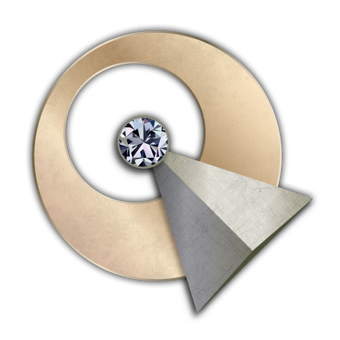 |
| Am I the only one who still believes in this symbol which represents the Vulcan philosophy of IDIC? |
They seem either unwilling or incapable of putting themselves in someone else’s shoes and understanding that “there but for the grace of G-d go I.” They can’t seem to understand that the circumstances of someone else’s life may not be like their own or that the rules we take for granted as descendants of white Europeans aren’t always the same for other ethnic groups or people of color.
It’s enough to make me want to grab them by the collar and shake some sense into them.
Yet at the same time, I know that these friends would have my back in a heartbeat if I ever needed them or got into any serious trouble.
Even my own parents who raised me to be open-minded and see things from other people’s point of view, seem to have become exceptionally narrow minded.
Now I’m no “lefty-snowflake.” I have a long and proud history of being a fence-sitter, whose preferred drink is Grape Nehi (It’s purple). I think both conservatives and liberals have valid concerns and that what is best for our country is a mixture of both their ideas in moderation and not some hardline, unbending adherence to a single political doctrine.
Everyone now seems so entrenched in their view and convinced that only they are right, that they can’t see what would be blatantly obvious to that alien outsider suddenly plunked down in the middle of us. That outsider would be astounded by the hypocrisy as they listened to people forgive or overlook unethical, immoral and in some cases criminal behavior by their own side’s leaders while condemning the other side’s leaders if they’d done the same thing.
But what I find most disturbing is that people not only seem to be willfully bind to our own history, but hell-bent on repeating it.
It’s clear to anyone with even a cursory understanding of world history that we are repeating the mistakes of the past.
Democracies across the world are electing populist strongmen who promote simplistic solutions to all our problems then proceed to undermine the very intuitions they claim to love in order to make their country’s great again.
It’s happening almost exactly as it did back in the 1930’s when Fascism swept through Europe in the wake of World War I and Great Depression, yet no one can see it. Supporters of these populists don’t seem to understand that by supporting policies that attempt to ostracize one group of people, that everyone ends up loosing because when the political winds change direction – and they always do – then they will be ones being ostracized and stripped of their rights.
More troubling are the ones who are noticing this swing toward totalitarianism and scapegoating of minorities but seem to be doing everything in their power to shoot themselves in the foot. They are prompting tactics and using slogans that purposely seem designed to frighten or push away any moderate who might be sympathetic to their cause.
Short rallying cries with no context such as “Defund the Police” and mob actions to pull down statues just play into their opponent’s hands that the left is just a bunch of anarchists.
Look, I get it.
I understand the anger out there and know exactly what protesters are saying when they chant things like “defund the police.” But when I have to have a 20-minute conversation with my mother to just try and convince her that that does not mean getting rid all police but using the money we currently give them for other things, then the slogan is self-defeating.
How do I know this?
Because that’s exactly what I thought when I first heard that slogan myself. My exact thoughts were “They can’t be serious! Without police, there would be anarchy!” Fortunately, I reacted like our alien friend might have, and sought clarification instead of just dismissing the protesters out-of-hand.
And that’s my point. If your slogan immediately turns people off, they aren’t going to listen to the nuances or details of your argument. Stop trying to come up with some catchy soundbite and put some real thought behind your words. Because those words DO matter!
{Sigh}
I keep trying to tell myself that I’m not the only one who sees this going on. Yet the more I look around and hear only silence from moderate voices, the more I feel like I’m alone.
Above the fray.
Watching the world teeter on the brink of total disaster and I’m powerless to stop it.
It makes me wish I really was that alien outsider who could climb aboard his spaceship and leave the planet. That way I wouldn’t have to see the people and places I love destroy themselves just to relearn the same harsh lessons of the past.

Sunday, May 31, 2020
A New Post-Covid Normal? I think not.
 |
| Like now, the wearing of masks during the Spanish Flu was strongly encouraged, but it didn't become the "new normal" after that pandemic past. |
As the country moves to reopen after two months of being locked down, I’ve been hearing a lot of talk about what the “New Normal” will be like after the Coronavirus pandemic passes.
I’ve heard people say that the handshake and shopping mall will go the way of the horse and buggy, face masks, the constant wiping down of surfaces and handwashing will be de rigueur, people will work from home instead of commuting to crowded offices and virtual meetings will replace the in-person kind.
I’ve even herd it suggested that people will be reluctant to gather in large groups anymore.
All this makes me want to role my eyes and ask these folks what box of Cracker Jacks they got their degrees from, because all these pontifications just show how woefully ignorant they are about both human nature and our own history.
To me, these folks are no better than the “Internet Experts” I wrote about last month, who, after five minutes of googling something, suddenly think they know more about any given subject than someone who has devoted his or her career to studying that subject.
Apparently these folks haven’t been paying attention to the newscasts they’ve been on, because I don’t know how else they could have missed all the stories about anti-lockdown protests. They may have started in Michigan and Pennsylvania in April, but they have now spread around the world to places like London, Germany and even Australia.
This just goes to show that we humans are creatures of habit and want to always return to doing something familiar no matter what.
Sure, on the face of it, these pundits’ post-Covid predictions make sense. Let’s face it, handshakes aren’t exactly the most sanitary of customs and crowding together in confined areas like theaters, malls, and sport stadiums or packing ourselves like sardines into airplanes and subway cars are the perfect mediums to spread a contagion. Logically if we wanted to avoid another pandemic – whether it’s the predicted second wave of Coronavirus – or some new and more devastating disease, we should stop doing these things right away.
 |
This clip from the Jan. 21 1919 edition of the Long Beach
Daily Telegram shows that even during the Spanish Flu
pandemic, that people were protesting wearing masks.
(Photo courtesy of Newspapers.com)
|
To paraphrase my favorite observer of human nature, “Star Trek’s” Mr. Spock, we humans aren’t logical. We are governed by our emotions and as recent political discourse in this country shows, we are no longer swayed by rational, logical arguments. We now appear only to respond to appeals to baser instincts.
The type of changes suggested by these “new-normallers” are a radical departure from our pre-Covid world and radical changes seldom result from one, large, single event. Those type of societal changes develop slowly over a course of years. And when there is a sudden shock to the status quo, any changes that do occur are often short-lived.
Don’t believe me?
Then let’s take a look at recent history.
The 911 attacks back in 2001 resulted in a dramatic re-evaluation of transportation security. In the weeks and months that followed, strict new security measures were put in place to prevent terrorists from boarding airplanes or sneaking weapons aboard them. Anyone travelling by air was closely scrutinized with few if any exceptions.
However, as time has gone on without any new attacks, those rules have gradually become more and more relaxed.
Sure, things haven’t returned to 1990s-levels of security, but now frequent flyers can sign up for a program that lets them bypass most of this enhanced security and in someplaces you don’t even have to take off your shoes anymore.
I know in part some of this is due to better technology like full-body scanners and bomb-sniffing baggage checking machines, but I feel like the real reason the restrictions were relaxed was because of the inconvenience factor. Flyers started to complain about how the delays caused by the new security measures were affecting their routines and the airlines, anxious to return to business as normal, were more than happy to accommodate them and pressure the government to relax security.
Still need convincing?
Let’s stay with our airline security example bit longer as we travel a further back in time to the early 1970s.
During that time there was a spike in "skyjackings" and for the first time ever, the government mandated that all baggage needed to be checked and people had to pass through metal detectors before boarding a flight. They also started to place sky marshals on what seemed like every single flight to deter would-be highjackers.
Even as a kid, I remember hearing how seriously everyone was taking these new security measures and how strict they were going to be. We were promised that they would put an end to highjackings once and for all.
And for a while it did.
By the late ’70s and early ’80s, skyjackings were a dim memory. The security had worked.
Then we got complacent. The extra security seemed unneeded, the cost of placing sky marshals on so many flights became unmanageable and while there were still baggage checks and x-rays at the airport, they were treated more like a formality than an actual security check.
 |
After the Spanish Flu, people once again packed together in New York City unbothered
by their close proximity as this photo from 1921 shows. The crowd had gathered
outside the New York Times building to follow the progress of the Jack Dempsey– Georges Carpentier fight in 1921. (Photo courtesy of The New York Times Photo Archive) |
This perfectly illustrates my point.
As memory of a crisis fades – and they all do—even the most vigilant among us revert back to doing things the way we’ve always done them. It is just human nature.
Changing the way a society operates is a hard, slow and incremental process. Even the smartphone revolution took almost a decade to change how we live our day-to-day lives. It only seems like it happened overnight. But in reality, it took that long for the marketing departments of Apple (iPhone), Research in Motion (Blackberry) and Motorola (Android phones) to convince us that we all needed to carry one of their devices. Even the notoriously anti-cell phone, Mrs. BlueScream grudgingly caved in and got one three years ago so she could function in the world.
Now, before you say attitudes towards airline security and smart phones are completely different from pandemics, let me draw your attention back to the Spanish Flu outbreak of 1918-19, to which our current situation has rightfully been compared.
A tad over 100 years ago, our nation was confronted with the same issues we are today. A mysterious new virus was sweeping through the country killing thousands and all the government could do to control the infection rate was to impose isolation and quarantine on the public.
Yes, virology was in its infancy and “wonder drugs” like penicillin were still a decade away, but we still understood the basic science behind it. We knew how the diseases like the flu spread. And yet by 1920-21, the world had returned to normal and people were back to gathering in large numbers in cities, went back to shopping, went back out to restaurants and gathering with friends and family just as they’d done before the pandemic.
It is a trend that continued straight from the 1920s right up to when the lockdowns began little over two months ago.
So why does anyone really expect anything to be different this time around?
As I said in my recent blog about history repeating itself, the past is indeed prologue and to expect a different outcome this time around not only defies logic, but shows an utter disregard and knowledge of our own history.
Thursday, March 31, 2016
Déjà vu all over again

One of the things about being an aspiring writer is that I tend to view life through the filter of a story-teller.
I’m always looking at things going on around me, trying to connect events into a coherent narrative as if I were a character being swept along by events in some Great American Novel.
And aside from the almost constant desire to go back and re-write certain parts of my past to improve that story (and my role as a hero in it), I can’t help but see certain patterns repeating around me.
Perhaps this comes from me being a history geek who has always wished he could hop into a time machine and experience what it was really like to live in whatever era has currently piqued my interest.
Usually these fantasies revolve around wandering down the fog-shrouded streets of Victorian London, getting involved in court intrigues and duels in 17th Century England and France or touring the great castles of Europe during their prime in the Middle Ages. But since minoring in history in college, the place and time I think I’d really most like to visit is early 20th Century America (1900-1955).
Unlike the other places and times I’ve mentioned, my view of this period of our country’s history is not colored by the mystery stories of Sherlock Holmes, the swashbuckling romance of “The Three Musketeers” or the adventure stories of “Robin Hood,” “Ivanhoe,” or the myriad of Dungeon and Dragon games I’ve played that were set in pseudo medieval settings.
No, my view of early 20th century America is informed though scholarly research I did to earn that minor in college. As a result I can’t help but notice that some patterns that happened at the beginning of the last century seem to be re-occurring at the beginning of this one.
Like the computer/Internet/electronics revolution we’re currently living through, the beginning of the 20th century also saw a great boom in technology. Electricity began phasing out other forms of lighting and power for the home; trains and expansion of the railroads, not to mention the invention of the automobile and airplane, began making once far-away and inaccessible places easier and faster to get to, and the advent of mass-production techniques from the previous century was transforming our sleepy, little agrarian nation into the world’s manufacturing powerhouse.
 |
| CREDIT: B. Deutsch at http://leftycartoons.com/ |
new technology replaced many jobs people used to do, rendering their skills almost obsolete overnight. Adding to the turmoil was the throng of new immigrants descending on U.S. cities drawn there by the promise of a better life, which fueled ant he anti-immigrant backlash not really that much different than the kind of hate-filled rhetoric spewed by some of today's political candidates.
Speaking of politics, I see a lot of similarities between the first two decades of the 20th and 21st centuries. As pointed out in the wonderful 2012 History Channel mini-series, “The Men Who Built America” these “Robber Barons” tried to control the political system through their proxies in the Republican Party, and even tried to derail the career of a reform-minded New York politician, Teddy Roosevelt, by sidelining him into what was then thought of as the dead-job of the Vice Presidency of the United States.
Now compare that to the way the Koch brothers are using the Citizen’s United decision, and I think the parallel becomes glaringly obvious.
But the one parallel that’s got me really worried is the one I see between the rise of Hitler in Germany during The Great Depression in the 1930s and the rise of Donald Trump in the aftermath of our own Great Recession.
Yes, I know a lot has been made of this already and I usually try to steer away from politics in my blogs. But as a Jew, I just can’t sit by and watch as another charismatic, demagogue tries to divide our nation under the guise of “Making America Great Again” by demonizing a whole class of people and blaming all our national problems on them.
(I’ve got news for you Mr. Trump. Whatever our troubles may be, this country STILL IS great! That’s why all the immigrants you want to throw out of the country want to come here!)
This is exactly the same tactic Hitler used to gain power. He focused the average German’s pent up frustration over their economic and political situation and turned it against the country’s biggest minority — the Jews.
And when late last year Trump said he’d close down all the mosques and make every Muslim carry an ID card, my jaw hit the floor. Hitler did the same to the Jews, closing all the temples and making them wear a blue, five-pointed star on their clothing with the word “Jude” (Jew in German) stitched on it. I half expected him to go on to suggest we should burn all Qurans and have people smash the windows of Muslim-owned businesses in a 21st century version of Kristallnacht
How people still cannot see the paralell between the two baffles and worries me.
It also baffles me when an elected official, Roanoke, Va. Mayor David Bowers, can justify the internment of Japanese-Americans in internment camps during World War II as a good thing when comparing it to the current Syrian refugee crisis. What's even more astounding about this is that Bower's is a Democrat, proving that our foolishness to repeat past mistakes isn't just limited to one of our political parties.
Pardon me, Mr. Mayor. But did you read the same history books I did? Because the use of those camps is considered one of this nation’s most shameful moments! How in good conscience can you even remotely suggest it was the right thing to do? Have you ever spoken to one of those internees? If not, may I suggest, starting with George Takei, Mr. Sulu from "Star Trek," who has first-hand experience of what it was like to live in one of those camps you blithely called a good idea!
Look, I'm not trying to belittle anyone's political views and I understand today's threats are different from those we faced at the beginning and middle of the last century. But it looks to me like the path we’re heading down is dooming ourselves to repeat the exact same mistakes we made 100 year ago.
We're better than that.
Or at least we should be.
So we all need to stop and take a good long look at our own history, because George Santayana was right.
“Those who cannot remember the past are condemned to repeat it.”
Subscribe to:
Posts (Atom)