
Showing posts with label Leonard Nimoy. Show all posts
Showing posts with label Leonard Nimoy. Show all posts
Saturday, February 28, 2015
Nimoy's legacy is more than just Mr. Spock
“Accepting death - by understanding that every life comes to an end, when time demands it. Loss of life is to be mourned, but only if the life was wasted.”
-- Spock to his younger self“Yesteryear” Star Trek – The Animated Series
 |
| Leonard Simon Nimoy March 26, 1931 – February 27, 2015 |
Childhood heroes hold an unusual place in our psyches.
They are often the first people to spark our fledging
imaginations and inspire us to do something we’d never dreamed of before, even
if all we do is to pretend to be like them at first.
As we grow older and more jaded, these childhood heroes tend
to maintain their place of honor in our personal pantheon of role models even
as other heroes we idolize later in life fall away as we become aware of their
all-to-human flaws and we begin to cynically pick them apart.
So it was with a profound sadness that yesterday I learned
of the death of one of my very earliest childhood heroes – Leonard Nimoy and
his alter ego Mr. Spock.
We never picture our heroes dying, especially those who have
accompanied us so long on our trek through life. We just we assume they will
always be there to inspire us and lift our spirits when we need it. After all
that’s what heroes do.
But now, like that
Robert Frost poem about two paths diverging in the wood, I find I must continue
down my path alone, while my hero takes the path to “the undiscovered country
from whose bourn no traveler returns.”
I mention poetry here because as well as being a talented
actor whose career spanned multiple decades, Nimoy was also an accomplished director (“Three Men and aBaby,” “The Good Mother,” “Vincent” and the third and fourth “Star Trek”
movies); a poet (“A Lifetime of Love: Poems on the Passages of Life,” “Come Be with Me: A Collection of Poems” ,
“Will I Think of You?” )
and a very active member of the Jewish community.
Yet despite his many accomplishments, it seems he will
always be remembered for playing a half human, half alien on a campy sci-fi
television series for three short years in the late ’60s and again in a couple
more times in the ’80s, ’90s and 2000s. But to paraphrase from his obit on NPR,
“instead of being a punchline, Leonard Nimoy gave the role of Mr. Spock
gravitas.”
Like the golem of Jewish folklore, he breathed life into the
role of the starship Enterprise ’s
logical science officer, a role that in a lesser actor’s hands might have come
off as a caricature of robot in a human body. He gave the part a quiet dignity
that convinced this 6 or 7 year-old who watched the show religiously in the
early ’70s that Mr. Spock was as “real” a person as the actor who portrayed
him.
“Star Trek” was my “gateway drug” into the world of science
fiction and for the longest time it was my only drug, mostly because – if you
will excuse the expression – of my fascination with the character of Mr. Spock.
When my friends and I used to play “Star Trek” there would
inevitably be arguments over who would get to be the captain. But I didn’t
care. I never wanted to be James T. Kirk. I always wanted to be the Vulcan science
officer.
And apparently I wasn’t the only one who felt that way.
Talking with my friend Christina soon after we learned of Nimoy’s passing, she
recalled one of the last conversations she had with her grandmother. They were
discussing their favorite “Star Trek” characters, and her grandmother said she
preferred the dashing, swashbuckling Captain Kirk. But Christina told her she
preferred nerdy characters like Mr. Spock.
“What does that say about me?” she asked, laughing.
Well it says she was a lot like a legion of fans who learned
from Nimoy’s portrayal of Mr. Spock, that there was nothing wrong with being
smart – and showing it – and that math and science could be cool.
But perhaps the biggest thing I learned from him, and the
reason he’s always remained my hero, is that he taught me to be comfortable in
my own skin.
Like Spock, who was the only alien among a large crew of
humans, I too felt like an outsider when I was growing up. Until fifth grade, I
lived in Rhode Island
where there weren’t that many Jews, and while the anti-Semitism wasn’t always
overt, I still remember a time I came home to find neighborhood kids had
scrawled swastikas on my family’s garage doors. I also vividly remember being
shunned because I didn’t celebrate the same holidays as the other kids. This
combined with the fact that I was never interested in the same things my peers
were made me feel like I had my face pressed against a window watching other
kids playing in a room I wasn’t allowed in.
But every night, I’d come home, turn on the TV and see Mr.
Spock dealing with the same sense of isolation as I was and watched how he earned
the respect of his crew. Suddenly I no longer felt like I was alone. I had a
role model I could emulate, and if I did, I’d eventually “fit in” and be
accepted.
And he was right. Eventually I found a “crew” of my own who
accepted me as I was and all those people who used to make fun of me for being
into weird and geeky things like computers suddenly need my technical expertise
to fix all their stuff. (Okay, some of those people still may not really accept me; I’ll settle for the cash they shell
over to me for fixing all their high-tech gizmos).
Recently I’ve also come to believe that being the “outsider”
or “observer” wasn’t such a bad thing afterall. I’d like to think it’s
benefited my writing, giving me a keener insight into human nature.
So, for giving me self confidence, a lifelong-love of technology
which I’ve been able to turn into a comfortable career, and for, I hope, making
me a better writer, I thank you Leonard Nimoy. May you go to your rest knowing
that to me and your legions of fans, you won’t be remembered as only Mr.
Spock.
You’ll be remembered for your most import role of all.
As our hero.

Monday, September 29, 2014
A Priestly Blessing from the planet Vulcan
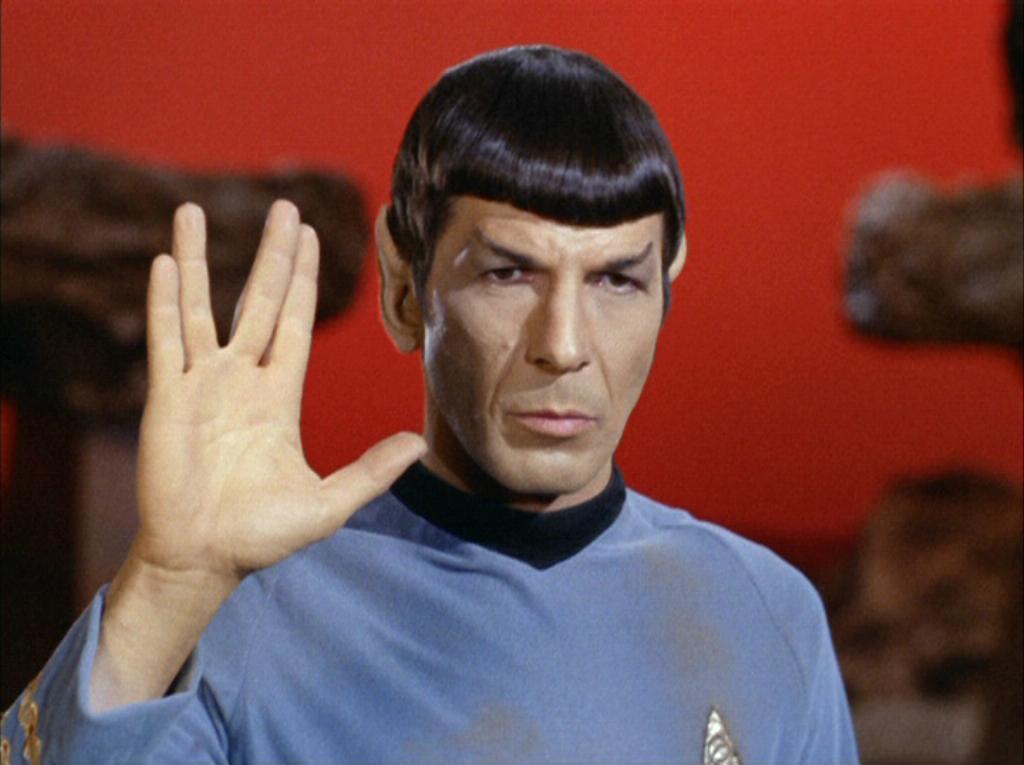 |
Not many people realize that Mr. Spock was really a space-going Kohanim, or Jewish priest. As proof, I offer you this picture of him administering Birkat Kohanim or Priestly Blessing to TV audiences in September of 1967.
|
It’s often said that religion and science don’t mix, nor should they.
And to a certain extent, I agree with that philosophy.
We should never let our religious beliefs stop us from exploring how and why things work in our universe nor should we ever alter the results of those scientific explorations just because they don’t happen to fit in with the precepts of our religion. Conversely, we should never let what we learn from science influence our belief in G-d.
Yet the same cannot be said when it comes to science fiction stories.
Some of the best Sci-Fi out there deals with the inherent conflict between these opposing points of view: faith and science. It has also, at least in my mind, given us one of the most iconic symbols in all of science fiction; the Vulcan hand salute and its salutation, “Live long and prosper.”
As some may or may not know, the now famous gesture was created by “Star Trek” actor Leonard Nimoy, during the filming of the episode “Amok Time.”
“I peeked. And I saw them with theirs hands stuck out beneath their Tallit like this toward the congregation and I went: Wow! Something really got hold of me. I had no idea of what was going on, but the sound of it and the look of it was magical.”
Who knew that only 20 or so years later, Nimoy would turn that “secret” Jewish ritual into a cultural phenomena?
I’ve known about the origins of the Vulcan salute for sometime now, but what got me thinking about it again was trying to come up with an idea for this month’s blog entry, which would fall right between Rosh Hashanah, the Jewish New Year and Yom Kippur, our Day of Repentance.
I can still remember the day I first saw my rabbi perform this ritual. I was in seventh grade and in our synagogue’s junior choir. We were singing as part of the big family service on Yom Kippur and we were standing off to the side and a bit behind the bema, or stage from where the Torah is read. Since we were on risers and already facing away from him, it was a bit hard for us to turn around when the rabbi asked, but like the young Leonard Nimoy, I just couldn’t resist peeking as our rabbi intoned the blessing that asks G-d to inscribe us for yet another in year in the book of life and grant us peace and prosperity.
My mind was blown as I saw him reaching out toward the crowd with his hands held in the to-me familiar “vee” fingered formation.
“My G-d,” I thought. “He’s essentially wishing us all ‘Peace and long life’ and asking G-d to ensure that the Jewish people, ‘live long and prosper.’ ”
“My G-d,” I thought again. “Vulcans are space Jews!”
If Mr. Spock hadn’t been my favorite “Star Trek” character before then (and he was), he became it right then and there. Over the years I came to realize that the Vulcan philosophy as depicted on the show isn’t all that different from what we Jews ask G-d’s help in becoming every year during these holiest of days. We seek to become a better people. A people who embrace cultural and racial diversity. A people devoted to learning. A people yearning for peace. And a people who act on the belief that ‘the needs of the many outweigh the needs of the few or one’ by going out and doing “mitvahs” or good deeds to leave the world a better place than the way in which we found it.
So in the spirit of both the Vulcan and Jewish people, I’d like to wish all of you out there in cyberspace, a slightly modified version of the Birkat Kohanim:
May G-d bless you and guard you.
May G-d shine His countenance upon you and be gracious to you.
May G-d turn His countenance toward you and grant you peace.
And may you all Live, Long and Prosper.
Subscribe to:
Posts (Atom)