
Monday, September 28, 2020
An apology
As some long-time readers of this blog may already know, each year between Rosh Hashanah and Yom Kippur I make an effort to apologize to everyone I know for any hurt I may have caused them during the past year and to forgive anyone for any wrongs that they might have done to me.
When possible, I try to do this in person, but most often I either send out a mass e-mail or post it here for everyone to read.

Not because I was feeling arrogant and stiff-necked as to
claim that I was perfect and have not sinned, when that’s clearly not the case.
Like everyone else, I admit that I am imperfect, have gone astray and have
sinned and transgressed.
It’s just that with
everything going on in the world this year, I wasn’t feeling in the spirit of
the Jewish High Holidays. The pandemic, the social turmoil, and the bitter political
atmosphere has left me feeling kind of numb. It seemed the best thing I could
do was remain passive and like current events, let these holidays wash over me,
until the tides change and better times return.
Then last night, while attending virtual services on my
laptop, something changed. We came to a part in the liturgy that seemed custom written
for 2020 even though it has been in Kol Nidre (the evening Yom Kippur service)
for as long as I can remember. Suddenly, I knew I needed to share it with you
all.
So as well as extending to you all my apologies and
forgiveness ask you to take the following words to heart:
Oh source of mercy, give us the grace to show forbearance to those who offend against us. When the wrongs and injustice of others wound us, may our hearts not despair of human good. May no trial, however server, embitter our souls and destroy our trust. When beset by trouble and sorrow, our mothers and fathers put on the armor of faith and fortitude. May we too find strength to meet adversity with quiet courage and unshaken will. Help us to understand that injustice and hate will not forever afflict the human race; that righteousness and mercy will triumph in the end.
My sincerest hope is that if we all take these words to
heart, act on these sentiments and make peace with those who don’t share our
views something good may come out of what’s turned out to be a horrible year.
Then maybe we all can be inscribed and sealed in the Book of Life for a new
year filled with blessings and happiness.

Monday, September 17, 2018
Making the world a better place, one apology at a time
And while I have written about doing this before, this year's message was a bit different, brought on by things I've been observing now for a while and find quite troubling.
So now I'd like to share my message with everyone here in the hopes that you too will take it to heart, and will join with me in making the world a better place...
An Apology...
It is that time of year again where I need to send out my usual Yom Kippur apology letter. But this time as I forgive all who may have offended or wronged me, and beg for forgiveness for any hurt I may have caused – knowingly or unknowingly – over the last 12 months, I’d like to ask all of you all a favor.
I'd like to do it a bit as I forgive all who may have offended or wronged me, and beg for forgiveness for any hurt I may have caused – knowingly or unknowingly – over the last 12 months, I’d like to ask all of you all a favor.
I’d like you all to consider joining me in making amends with everyone you know, whether you celebrate Yom Kippur or not.
I ask this of you because I’ve been noticing a hardening of hearts in our society and a slide toward intolerance of those who don’t agree with us or our opinions.
It has made the world a meaner place and made it acceptable to purposefully hurt another person with little regard for anyone’s feelings but our own.
This, of course, runs contrary to the spirit of Yom Kippur, where Jews around the world are not only supposed to atone for their sins against G-d, but must also seek forgiveness from others who we might have wronged over the last year. As it is written in the Talmud, a collection of writings that covers centuries of Jewish law and tradition:
“For sins between man and G-d Yom Kippur atones, but for sins between a one and one’s fellow, Yom Kippur does not atone until one appeases one’s fellow.”So, in addition to my usual litany of apologies I make to you every year, I’d like to add this:
If I have been less tolerant or dismissive of your views and/or opinions, I apologize and promise to try and be more understanding of them in this coming year. I also promise to try and realize that I do NOT need to prove your beliefs and opinions are wrong just to justify my own. Nor do I need to prove you wrong just to delude myself that I am somehow morally superior to you, because only G-d can make that judgement, not me.
I further apologize if I offended you in my zeal and perhaps self-righteousness to support those causes I believe in.
I ask you all to join me in making this apology to everyone you know, because another part of the Yom Kippur tradition is Tikkun Olam – which means doing an act that “repairs the world.”
I know that making an apology doesn’t seem like it can make a big difference in the world. But it could make a small difference to our little part of it. And just imagine the kind of change that could happen if everyone decided to repair their small corner of the world.
Perhaps then we could live up to the potential for good that G-d gave to all of us and earn our place in the book of life for another happy and healthy new year.
Friday, September 29, 2017
When one chapter ends, another begins

One of the side effects of being a story-teller is that you’re constantly looking at life as if it was a novel and trying to arrange the things that happen to you into neat little narrative threads as if you were a character in one of your own stories.
Unfortunately, life doesn’t always cooperate. It’s a messy affair, filled with disjointed and often unrelated scenes, unresolved themes and/or plot threads that wind up going nowhere.
But every once in a while, life seems to imitate art -- or is it art imitating life? -- and things happen in such a way that even the most oblivious English Lit major can’t help but see the theme a heavy-handed author is trying to get across to his or her reader.
Well one of those moments happened to me last week. After almost 21 years, I left -- or was kicked-out of (depending on your point of view) – the company I have spent a good portion of my adult life working for.
Losing a job is a dramatic event in and of itself. And being laid off with half of your colleagues because the company you’ve put so much blood, sweat and tears into was sold only heightens the matter.
But that wasn’t solely the cause of my “living inside my own novel” moment.
My last day happened to coincide with the start of the Jewish high holy days.
For those not in the know, the period between Rosh Hashanah -- the Jewish New Year -- and Yom Kippur -- the day of atonement -- is a time of both endings and beginnings where Jews all over the world reflect back on the year that’s been and prepare for the year ahead. So the fact that I was leaving one job and starting another during this period seemed like a “happy” coincidence.
I put happy here in quotes, because leaving a job I’ve had for so long and having to say goodbye to one of the nicest groups of people I have ever worked with was certainly very sad. And like the closing of the old year we mark on Rosh Hashanah eve, it was certainly a very definite ending. It had me reflecting back on all the good – and sometimes not-so-good – times I had there.
To many, that event would mark the end of the story of their working life. For me however, it only marked the end of one (major) chapter of my life. Like turning the page in a book, a new chapter began for me the following Monday morning.
You see, I was lucky enough to get a three-month warning that the layoff was coming and I was even luckier to find what appears to be a better job before I was let go.
While thanking G-d, the ultimate author of all things, it dawned on me this was the perfect metaphor for Yom Kippur, which began the same week I started my new job. Because on Yom Kippur we Jews not only ask G-d to forgive all our sins, but also ask the Almighty to turn the page on our past and begin a new chapter for us in the Book of Life.
I’d like to believe the timing of this event was no accident. That it is a reminder that the “Great Author in the Sky” has a plan for all of us, even if -- like the characters in some of my stories -- we can’t always see where the plot is taking us from our limited perspective.
So to each and every one of you out there and to all my former colleagues who weren’t as lucky as me to immediately find a new job, may G-d inscribe you for nothing but blessings in the Book of Life for another year.
Monday, September 29, 2014
A Priestly Blessing from the planet Vulcan
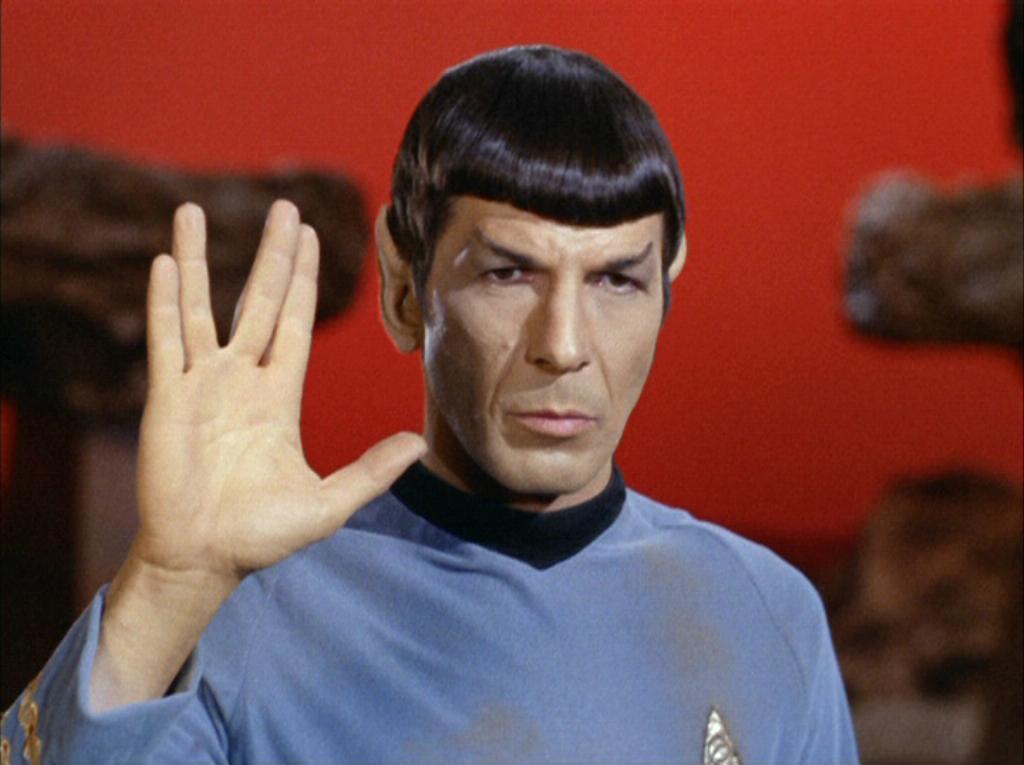 |
Not many people realize that Mr. Spock was really a space-going Kohanim, or Jewish priest. As proof, I offer you this picture of him administering Birkat Kohanim or Priestly Blessing to TV audiences in September of 1967.
|
Thursday, September 20, 2012
Rebooting the soul
Every year about this time, my friends, relatives and colleagues get an e-mail from me with the subject line: An Apology.
In the e-mail I apologize to them for anything I may have done over the past year, knowingly or unknowingly, that may have offended or hurt them in some way. I also let them know that I forgive them for anything that they might have said or done to me that may have offended or hurt me in some way during the last year.
I do this because I am Jewish and during the period between Rosh Hashanah, the Jewish New Year; and Yom Kippur, the Day of Atonement; we Jews are supposed to do a lot of soul searching and repent for all our sins so we can start the new year with a clean slate. But as our teachings tells us, “For transgressions against G-d, the Day of Atonement atones; but for transgressions of one human being against another, the Day of Atonement does not atone until they have made peace with one another.”
I realize that I should probably say this to each person face-to-face – and I do try to do this – but because it is logistically impossible for me to meet with all my family, friends and colleagues who are scattered all over the country during these ten holiest days of the Jewish year, I am forced to resort to a more impersonal, technological method to make my apologies.
Sometimes I think this is sort of cheating, because it is much easier to write the words “I’m sorry” in an e-mail than to say them to someone’s face. Yet to say I’m sorry to only the people who happen to be geographically near me and not to those farther away doesn’t seem right to me either.
This was very much on my mind this past weekend as I attended the High Holiday services at my temple, when my rabbi began talking to us about the concept of “Teshuvah.”
Teshuvah means to “repent and return,” and as our rabbi talked about this, he said something that not only made me feel better about my use of e-mail in my attempts at Teshuvah, but also appealed to my inner geek. He said that no matter how bad the sin, if you really and truly are repentant, G-d will forgive you and will not punish you.
“Is that cheating?” he asked the congregation. “If you do the crime should you not do the time?” Is G-d granting us a metaphorical, if not somewhat literal “get out of jail free card?”
His answer to that was no. And this is why:
Because if you truly repent and change your ways, then you are no longer the person who committed the sin, he explained. “It is like hitting the reset switch,” he said.
The moment my rabbi said that, I pictured some heavily hand descending from the sky and hitting some invisible Ctrl+Alt+Delete (or for you Mac users out there: Control+Command+Eject ) keys on our heads and rebooting us the way we reboot a misbehaving computer.
Of course the moment I thought that I felt guilty (as I said, I’m Jewish, and we’re genetically programmed to feel guilt at the drop of a yamaka). I shouldn’t be thinking such silly and irreverent things during this time of the year!
But the more I thought about it, the more I didn’t think it was so silly after all. Rebooting a computer will clear out the memory and will often get rid of any corrupted information which is causing the computer to misbehave. That is why the first thing any computer geek you’ve ever gone to for help will ask you if you’ve tried rebooting. And wouldn’t it be cool if there was some magic button combination that we could press within ourselves that would clear out our memories and get rid of all that bad information which causes us to misbehave and sin?
Wouldn't it be nice if our prayers acted like that simple “three-fingered-salute” that could erase all our evil inclinations and make us live up to the greatness G-d sees in all of us? And wouldn’t it be nice if, like rebooting a PC, that transformation could be achieved in mere minutes instead of having to spend all day fasting and praying at the synagogue hoping that we can stick to the promises we make to ourselves to become a better person?
But we alas, we are not computers. It takes more effort for us to change our ways than just simply pressing a few buttons, which in the end, I guess, is a good thing. It is that struggle to find the divine in each of us that makes us human. Unlike computers there is no app we can download nor is there a single program we can run to help us find that spark of divinity. We are all individuals and we each must find our own path. For some that may mean using personal wealth or power to further some worthy cause, others might find it by healing the sick, feeding the hungry or by volunteering to help build homes for the homeless. Still others may find it by simply being a good friend, or by visiting with the sick or just through a kind word or deed said to a stranger.
G-d understands the individual nature of our path to redemption. “ You do not ask me: 'Why have you not been great as Moses?' ” one of our Yom Kippur prayers reminds us. “You do ask me: 'Why have you not been yourself? Why have you not been true to the best in you?' ”
Yet finding and remaining on that path to being the best of yourself is not easy. During our lifetimes, circumstances seem to force us to take many detours and inevitably we wander down many blind alleys. We rely on our faith to be our GPS, keeping us on the straight and narrow. But still we go astray.
I suppose then, that that makes the period between Rosh Hashanah and Yom Kippur the time when G-d “downloads” updated maps to us. Hopefully this year, I will be able to follow those directions better than I did last year and avoid having to worry about the need to again reboot my soul next year.
Ken yehi ratzon. (May it be God's will).