
Monday, September 29, 2014
A Priestly Blessing from the planet Vulcan
 |
Not many people realize that Mr. Spock was really a space-going Kohanim, or Jewish priest. As proof, I offer you this picture of him administering Birkat Kohanim or Priestly Blessing to TV audiences in September of 1967.
|
It’s often said that religion and science don’t mix, nor should they.
And to a certain extent, I agree with that philosophy.
We should never let our religious beliefs stop us from exploring how and why things work in our universe nor should we ever alter the results of those scientific explorations just because they don’t happen to fit in with the precepts of our religion. Conversely, we should never let what we learn from science influence our belief in G-d.
Yet the same cannot be said when it comes to science fiction stories.
Some of the best Sci-Fi out there deals with the inherent conflict between these opposing points of view: faith and science. It has also, at least in my mind, given us one of the most iconic symbols in all of science fiction; the Vulcan hand salute and its salutation, “Live long and prosper.”
As some may or may not know, the now famous gesture was created by “Star Trek” actor Leonard Nimoy, during the filming of the episode “Amok Time.”
“I peeked. And I saw them with theirs hands stuck out beneath their Tallit like this toward the congregation and I went: Wow! Something really got hold of me. I had no idea of what was going on, but the sound of it and the look of it was magical.”
Who knew that only 20 or so years later, Nimoy would turn that “secret” Jewish ritual into a cultural phenomena?
I’ve known about the origins of the Vulcan salute for sometime now, but what got me thinking about it again was trying to come up with an idea for this month’s blog entry, which would fall right between Rosh Hashanah, the Jewish New Year and Yom Kippur, our Day of Repentance.
I can still remember the day I first saw my rabbi perform this ritual. I was in seventh grade and in our synagogue’s junior choir. We were singing as part of the big family service on Yom Kippur and we were standing off to the side and a bit behind the bema, or stage from where the Torah is read. Since we were on risers and already facing away from him, it was a bit hard for us to turn around when the rabbi asked, but like the young Leonard Nimoy, I just couldn’t resist peeking as our rabbi intoned the blessing that asks G-d to inscribe us for yet another in year in the book of life and grant us peace and prosperity.
My mind was blown as I saw him reaching out toward the crowd with his hands held in the to-me familiar “vee” fingered formation.
“My G-d,” I thought. “He’s essentially wishing us all ‘Peace and long life’ and asking G-d to ensure that the Jewish people, ‘live long and prosper.’ ”
“My G-d,” I thought again. “Vulcans are space Jews!”
If Mr. Spock hadn’t been my favorite “Star Trek” character before then (and he was), he became it right then and there. Over the years I came to realize that the Vulcan philosophy as depicted on the show isn’t all that different from what we Jews ask G-d’s help in becoming every year during these holiest of days. We seek to become a better people. A people who embrace cultural and racial diversity. A people devoted to learning. A people yearning for peace. And a people who act on the belief that ‘the needs of the many outweigh the needs of the few or one’ by going out and doing “mitvahs” or good deeds to leave the world a better place than the way in which we found it.
So in the spirit of both the Vulcan and Jewish people, I’d like to wish all of you out there in cyberspace, a slightly modified version of the Birkat Kohanim:
May G-d bless you and guard you.
May G-d shine His countenance upon you and be gracious to you.
May G-d turn His countenance toward you and grant you peace.
And may you all Live, Long and Prosper.

Sunday, August 31, 2014
Proof I can create more than just a virtual desktop
I liked that slogan so much, I made it the motto for my company, Price Consulting Services, LLC and even put it on my business cards.
Well four years on, I’ve finally gotten a chance to prove I could actually do just that.
In fact, I’ve spent just about the entire month of August building a mammoth, 9½-foot-wide news anchor desk for a local online sports show called Game On.
While you can check out the fruits of my labors at the link above, I’d thought I’d share with you a series of pictures documenting its construction, from picking up the wood at my local big-box hardware store to its final delivery on set.
STEP 1: Designing the desk in SketchUp
 |
 |
 | |
STEP 2: Buying the lumber
 |
  |
| It's truly amazing how much lumber you can actually fit into a Honda Civic! Everything you see on the cart at left, actually made it into my truck and stayed their for the 20 minute drive home! | |
STEP 3: Cutting the parts down to size:
 |
 |
| Using my compound miter saw, I cut out all the various parts for the desk base and then used my table saw to square up all those parts. It took me an entire day to do this. | |

 |
 |
The top and bottom sub-assemblies had to be glued up in a few stages because the weird angles made clamping it all at one nearly impossible.
| |
 |
 |
After the top and bottom sub-assemblies dried, I attached them to the legs to form a right and left base. At 9.5 feet wide, I had to make the desk in two parts, so the finished product would be easier to move.
| |

STEP 7: Fitting the base to the top
 |
 |
STEP 8: Covering the base
 |
 |
STEP 9: Assembly complete!
 |
 |
| From the front, (left) the desk has a nice rail and panel look to it. But since the rear (right) will never appear on camera (at least not on purpose anyway!) I didn’t make any attempt to hide the 2x4s that give the desk its strength. The circular knobs on the center legs and top center support are actually window latches that are used to lock both sides of the desk together. | |
STEP 10: Painting
 |
 |
| The desk got two coats of gray primer (left) and after that dried, I began to apply its final topcoat (right): a glossy black paint.
| |
 |
 |
The "Game On" program is shot on a green-screen stage so a CGI background can be added later. The producer has since told me that now that they have such a nice desk, they are thinking of building a real set around my desk! | |
Thursday, July 31, 2014
Take two tablets and call me in the morning….

It happens every year as July dwindles its way into August and is as inevitable as the swallows returning to Capistrano or salmon’s need to swim back up stream to its spawning grounds.
“So,” my wife will ask me. “What do you want for your birthday?”
After assuring her that her continued presence in my life is present enough, and watching her roll her eyes, she’ll repeat the question.
“No seriously. What do want?”
As a tech guy and self-proclaimed gadget geek and woodworker, you think that I could give her a list a mile long. Yet lately, I’ve been hard pressed to even come up with two or three things that: A) we can afford, B) won’t land me in divorce court or on the couch for a week or two and C) that I really, really want.
At this point in my life I seem to have all basic hand and power tools that a semi-serious woodworker/DIYer needs (or at least all the tools that will comfortably fit in our garage and still allow us to park our cars in there), and while my tech gear is kind of on the old side, it is still more than sufficient for what at I use it for.
“What about a Kindle Fire?” she suggests. “Or maybe one of those Surface things. I’ve seen you looking at them…”
Every time she suggests this, I think about it for a long time. After all, not many wives would volunteer to buy their husbands an expensive toy. (And yes, I do have a great wife! That’s why I stay married to her!) But in the end, I wind up turning her down, because to me, that’s what these tablets are – expensive toys.
Now I’m not saying tablet computers like the iPad, Surface, or any one of the various Android-powered devices out there aren’t useful or convenient. The 195,435,004 people who went out and bought one of them in 2013 would seem to prove that. I’m just saying that at the moment, I don’t see them being very useful for me.
I don’t travel a lot and do most of my reading (and a good bit of my writing too) floating in my inflatable pool chair in the summer. So having my entire library of books and magazines at my fingertips isn’t as big a deal for me as it is for my wife, who does travel a lot. So if I finish a book or magazine I’m reading, it’s only a few steps to the house to grab another, while for my wife, who might be on a plane somewhere, grabbing another book from our bookshelves is a bit more problematic.
Also until they make those tablets completely water proof, I would not dream of taking one near the pool. If the book I’m reading gets splashed or I accidentally drop it in the water, I can fish it out, place it on the side of the pool to dry, and aside from some wrinkly pages go back to reading it within 20 minutest. Drop a Kindle, Nook, or worse yet an iPad or Surface in the water, and you’ve got yourself one very expensive paperweight.
I know you can do more with these devices than just read e-books. You can watch movies or stream videos from the Internet on them, e-mail, browse the web and even open and work on office documents. But I can do all that stuff on any one of my old laptops.
Even my oldest unit, an eight-year old Dell laptop with only 2gb of RAM can handle these tasks with aplomb and I find having a built-in keyboard much more useful than having to hunt and peck on an on-screen keyboard that offers no tactile feedback.
So for now, I can’t see spending money (or my wife’s money) on something that’ll I’ll only use until the novelty wears off then revert back to one of my old laptops because, to me, they are more convenient.
What would make me change my mind about getting one?
Well price would be always be a factor, so it would have to be cheaper than buying full-fledged, laptop. Right now, for the price of an iPad or Surface, I can buy a mid-range laptop that has lots more processor power and memory than any tablet on the market and wouldn’t limit me to just their simple apps. On a laptop I can run any software I already have or need.
It would also have to be rugged. As a tech, I’ve seen way too many of these devices get broken, and since they are not easy to fix and I’m a bit of a klutz myself, I’d want them to be able to withstand multiple drops from about table-top height without screens cracking or the electronics fritzzing out. Plus, they’d have to be water-proof, not just water resistant. I want to be able to drop one of these things in my pool and be able to fish it off the bottom five minutes later and have it still working.
Thirdly, I’d want it to have two screen modes: a high-definition color display for when I’m inside and an e-ink display so I can actually use it outside in direct sunlight. Kindle’s Paperwhite displays are great for reading books outdoors, and I’ve even seen some e-readers that can convert pictures into black and white so you can read a magazine page even with the sun shining over your shoulder.
But wouldn’t it be cool if a tablet could sense it was outdoors and switch to an e-ink display mode for your apps, so you can do more than just read outside? Yes, I realize this probably would not work for everything, but for writing and editing office documents, e-mails and even some basic web browsing, it should be just fine. And since that’s what I’d mostly be doing with mine…..
Finally, I’d want it to come with a stylus and an app which would recognize my handwriting and convert my scribbling into an editable text and save it to a .txt, .rtf or even .doc or .docx file. That way I could replace the clipboard and pencil I use when writing in the pool and get back the few hours it takes me to type all those pages into Microsoft Word on my computer.
Of all my requirements, I think this last one is most obtainable. There are a few apps out there that are close to doing this already. But until they prefect them and the other things I mentioned, I think I’ll keep passing on a tablet computer, and stick with my fallback gift: clamps.
Why do I want clamps, you ask?
Because a woodworker can never have too many vises.
Monday, June 30, 2014
The Geeks have inherited the Earth
(and it’s about damn time too!)
 |
| This comic, courtesy of JoyOfTech.com, proves our point. |
Anyone who was interested in science – and by extension, science fiction; was fascinated by personal computers which were just beginning to make their ways into people’s homes; and who’d spent his or her free time playing games where imagination was more important than physical prowess, were looked upon as being weird, and worthy of ridicule and scorn.
But sometime during the last the 30 years we geeks went form being Urkel to Adam Savage.
And it’s about damn time too!
Without us, there’d be no smartphones; social networks, e-mail, or even Google. Hell there wouldn’t even be an Internet – which I guess, depending on your point of view, may or may not be such a bad thing.
But all the modern conveniences you now take for granted were invented by us geeks, who the mass media used to portray as bespectacled, pocket-protector and flood-pants wearing wimps, with high-pitched, nasally voices.
Well who’s laughing now?
We are.
And it’s not that stereotypical honking laugh that you all think we have.
It sounds more like this.
 |
Today's geeks look and sound more like Adam Savage than the
Nerds from "The Revenge of the Nerds" movies or Steve Urkel from the "Family Matters" TV show. |
That’s right, it’s the sound of us laughing all the way to the bank as you scramble to buy the latest tech gadgets we’ve created and then again when you have to pay us to fix them or teach you how to use them.
And, no, all those tablets/smartphone/computers/Apps you can’t live without don’t really need to be so hard to use. We could have made them simpler, and would have, if you guys had been nicer to us in high school.
Karama baby, it’s a bitch….
Now I guess you could argue that it was Steve Jobs, the co-founder of Apple Inc. and the brains behind some of its most iconic devices, who first began to bring some chic to us geeks in the late ’90s. But while there is little doubt that his creations earned him the public’s adoration, the man himself was no Mr. Congeniality. By all accounts, he was a difficult man and had a reputation as kind of jerk.
Other contenders for the title of “First Cool Geek” might be Bill Nye, “The Science Guy” whose television show aired on PBS and a few other stations from 1993-1998; or to a lesser degree, writer, producer and director Joss Whedon whose genre TVs shows like “Buffy the Vampire Slayer,” “Angel,” and “Firefly”; films: “Toy Story,” “Alien: Resurrection,” and “The Avengers”; and web series: “Dr. Horrible’s Sing-Along Blog” have helped bring mass appeal to stories once thought the domain of only geeks.
Regardless of who was first, right now I think the poster boy for the modern “hip” geek belongs to “Mythbusters” co-host Adam Savage.
For a while now, I’ve been watching him on YouTube and based on what I’ve seen, I can’t think of any better role model for today’s geeks. He’s crazy smart and every bit the creative genius Steve Jobs was, but unlike the former Apple CEO, he is personable. He’s the type of guy you’d want sitting in on your Dungeons & Dragons game and could even imagine discussing who was the best captain in “Star Trek” or whether the Enterprise could beat the Battlestar Galactica or an Imperial Star Destroyer in a space battle.
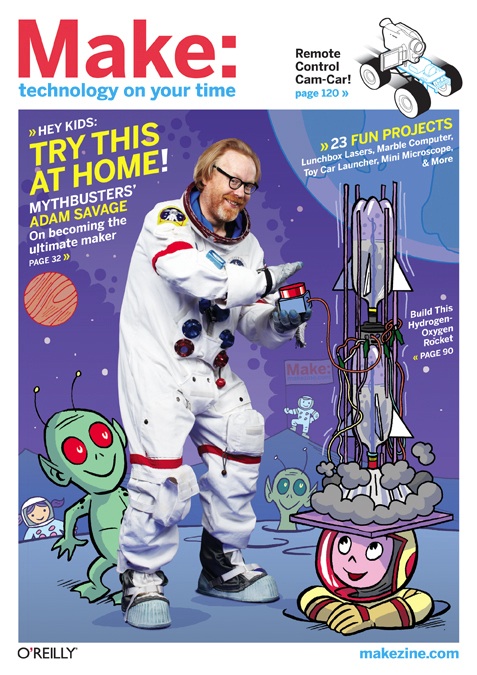
But his affable personality and fame aren’t the only reason why I’d crown him “King of the Geeks.” He’s become the face of the Maker Movement and actively campaigns and encourages people to get out and make stuff they want instead of wishing it existed.
The enthusiasm which he speaks on this subject is infectious and after watching videos of him speaking at Maker’s Faires, graduation ceremonies and fan conventions, he inspired me to turn my DIY and woodworking skills to a slightly less practical pursuit: building my own lightsaber.
I’ve always wanted one ever since I saw “Star Wars” when I was 13, but the cost of buying a film-accurate replica seemed way too exorbitant.
The one I built doesn’t do half the things those replicas I could have purchased can, but I think it’s way cooler, because I was able to built it myself to my own specifications. In addition to the bragging rights and pride of having made it myself, I also learned a new skill doing it – electronics.
Learning to wire together a few LEDs, and a switch and battery into a simple circuit may not seem like much, but from that experience I learned enough to fix a flatbed scanner of mine that had suddenly stopped working and am now planning on integrating some electronics into the woodworking projects I build during my summer vacations.
This is Adam’s point.
Get out there, find what inspires you and learn how to build it.
It doesn’t matter “if the project kicks you’re ass,” he preaches. Stay with it and persevere. What you learn from that experience will be even more invaluable than your sense of accomplishment and lead you on to bigger and better things.
I think that’s an important message, given the current age of increasingly shrinking school budgets where art and shop programs are getting axed. Children should be encouraged to indulge their imaginations and build things.
Who knows, that geeky kid in your school who’s trying to build his own Iron Man armor out of cardboard and a handful of electronics parts he picked up at Radio Shack might just grow up to be the next Steve Wozniak, Bill Gates or Eric Schmidt.
So don’t make fun if him. Encourage him instead. Hell, even volunteer to help. You never know what you might learn.
And if you are very, very lucky, that kid might remember it and make the next generation of high-tech gadgets simple enough for even non-geeks to use!
Friday, May 30, 2014
Privacy in the modern world is really an illusion
“Yeah,” I replied, closing the lid of my laptop. “About that….”
Undeterred, he went about his rant how we live in an oversharing world, where people seem to believe “that every single errant thought, routine errand and bowel movement is worth a chirp!”
“Tweet,” I corrected.
“Whatever!” he said disgustedly. “My point is what the hell happened to the idea that other people should keep their noses out of my business? In my day, people used to get upset when they found out other people were eavesdropping into their private affairs. Today it seems like people get upset if the world doesn’t know what they are doing!”
I smiled sadly at the Elder Geek. “Welcome to ‘The Brave New World’ of Edward Snowden and the NSA, WikiLeaks, Google and Big Data.”
 “I think you mean ‘Big Brother’,” he corrected.
“Whatever,” I said.
The Elder Geek frowned. “How can people be so casual about this? Doesn’t anybody care that there is all this private information floating around about them for everyone to see!”
“Why should they care, when no one else does?” I asked. “With red-light and security cameras popping up on virtually every corner and their own personal devices spying on them, people just seem to take it for granted that privacy in the modern world is really an illusion. Like the citizens of Oz, we’ve all been fooled into ignoring the man behind the curtain.”
“Why that’s outrageous!” the Elder Geek stammered.
I nodded. “You’re right, but people have become so enamored by the magical powers of their smart phones, TVs and thermostats; tablet computers and customer loyalty cards and the convenience of Internet shopping, that they don’t seem to care that both their every physical and online move is being tracked. Like junkies, we’ve become addicted to our high-tech devices and now we can’t live without them.”
“Well they should learn!” the Elder Geek grumbled.
“Easier said than done. Unlike the good old 1980s, it’s nearly impossible to keep all your data private. Julia Angwin, an investigative reporter for the Wall Street Journal , tried it and wrote about it in her book, “Dragnet Nation: A Quest for Privacy, Security and Freedom in a World of Relentless Surveillance.” Among the things she tried was not using Google nor any of its related services and she even resorted to carrying a “burner” cell phone, but she still found that for the average person, it was nearly impossible to keep her anonymity online. You can hear her talk about her experiences in this interview on NPR’s “Fresh Air” program.
“So what you’re saying is that there is no hope and we’d better get used to Big Brother…or Big Data or whomever watching our every move?” he asked resignedly.
“No. Not exactly. Earlier this month, the European Union Court of Justice came out with a ruling stating that people have ‘the right to be forgotten,’ and part of that right includes letting people erase traces of their digital past from the Internet.”
“Well that’s encouraging!” he said brightly.
“Yeah well don’t get your hopes up yet,” I said trying to put a damper on his expectations. “As much as I agree with that sentiment, the courts over there are going about it the wrong way. They are putting the onus on Google to delete that information from their search results.”
“So what’s a matter with that?” he asked.
“Well it’s like asking a carpenter to put a self-closing hinge on the barn door after the horse has escaped, instead of putting a lock on the door BEFORE the horse got out,” I explained. “Just making Google exclude the information from their search results won’t get rid of the data. I know it’s hard to believe, but there are other search engines out there besides Google. (Anyone remember AltaVista? Yahoo? Dogpile? Bing?) And it won’t stop the company that originally collected that data on you from using that outdated information in the future. What the courts should have really mandated is that the companies who collect your data be legally obligated to purge their information on you every few years. Then we will be getting somewhere.”
The Elder Geek pondered this for a moment. “So how do you propose doing this?” he asked.
I gave him a mischievous smile. “Why sharing it with everyone on Facebook and Tweeting about it with #DeleteMe of course!”
Sunday, April 27, 2014
There’s Gnome place for technology in this yard
 |
| A rosebush by any other name in my garden would still be just as dead. |
Where the hell are my #@%^! lawn gnomes?!
 |
| These are NOT the Gnomes, I'm looking for.... |
The kinds I've been waiting for are the ones that live under mushrooms and come out at night when everyone’s asleep, clean up the garden beds, pull weeds and keep the lawn neatly trimmed.
I've lived in my house now for over 15 years and I have seen neither hide nor hair of them! And it’s not like I don’t have enough mushrooms growing in my yard. Just ask my neighbors…
If I don’t see evidence soon that they are doing at least some of my yard work, I’m going to evict their pointy little heads once-and-for-all!
Now I don’t want to give you the wrong impression. I’m not lazy. In fact, I’m a die-hard DIYer and look forward to doing projects around my house. But what I like about most DIY projects is that after you complete them, they are done.
Completed.
Finito.
There’s no going back week after week and doing the exact same mindless task over and over again. No pulling weeds, no raking leaves or cutting the grass.
Those are jobs best suited to lawn gnomes or technology.
Unfortunately in this super, high-tech age of Internet enabled everything, no one’s come up with a way to take the drudgery out of yardwork.
Apparently there ain’t no App for that!
 |
Ok, so a robot mower made by Cyberdyne Systems
and controlled by Skynet may not be such a good idea after all.... |
What could possibly go wrong with devices like these?
I mean besides the whole robot-apocalypse thing, where all our machines and computers go all “Skynet” on us and decide to wipe out humanity.
Sigh….
Well, I guess until the geniuses at Apple, Google and/or Microsoft realize we don’t need yet another lighter/faster/smarter phone, tablet PC, watch, thermostat, refrigerator or eyeglasses and start making devices that really do make our lives easier, I’m going to have to rely on those lazy, good-for-nothing lawn gnomes to help me with my yard work.
Maybe I should start looking for them in the spot where my house elves have disappeared to. ’Cause judging by the layer of dust on my furniture, the dog hair on my rug and the laundry piling up in the hamper, they have haven’t been working lately either.
Sunday, March 30, 2014
Everything I Really Need to Know I learned on YouTube
 As a writer and lover of the English language, it pains me to admit that when it comes to acquiring a new skill, I’m more a visual learner than a word guy.
It’s not that I can’t pickup how to do something by just reading an article or following a step-by-step guide in a book or magazine. But give me a series of pictures to look at, and I seem to instantly understand how something comes together (or, more often, gets taken apart).
I’ve always been that way, from the model kits I used to put together as a kid to the woodworking magazines I read today, which feature lots of photos and diagrams of projects in just about every stage of construction.
Even in my day job as a systems technician for a Pennsylvania-based news media company, I find myself turning time and again to visual guides to keep the company’s ever-growing array of high-tech gadgets running.
Contrary to popular belief we computer geeks aren’t born with an innate knowledge of how to breakdown and fix every piece of technology that lands on our workbenches. Sometimes even we need to turn to the Internet to find out how to repair something.
Oh and speaking of Apple, my next trip to the site was to find out how to replace the digitizer (glass screen) on an iPad, that one of our employees had cracked – again. I’ve also used a Youtube video to help me replace the broken headphone connection on my third generation iPod and numerous times to find out how to accomplish a number of special effects in Adobe Photoshop.
also found myself turning to it for non-work stuff. I’ve mostly used it to find out how to do things in my woodworking shop, like cutting dovetails or tuning up some of my tools. But on occasion I’ve used it for more mundane things like finally figuring out how to fold a fitted bottom sheet of a bed, and that got me wondering what other “life- skill” videos I could find on the site.
So I recently went looking, and was somewhat surprised by the answer.
There were hundreds if not thousands of these types of videos! Now some of them are probably of dubious quality and I wouldn’t necessarily trust the self-proclaimed experts who made them, but the are still a staggering number of them. This reminded me of a book written back in the late 1980s, by a man named Robert Fulghum: “All I Really Needed to Know I Learned in Kindergarten.”
But just as important as learning how to share and “doing unto others as we have done unto us,” are knowing how to bath ourselves and taking care of our own personal hygiene; dressing; eating, feeding and cooking; doing house work; managing money; shopping; transport and even child and pet care.
And if you somehow missed learning any of these skills while you were growing up, YouTube has you covered. I found plenty of videos which cover these topics and I’ve sprinkled them throughout this blog. Some are down right amusing and some helpful (Yes, I did finally learn to fold that fitted bed sheet from a YouTube video).
So Mr. Fulghum, I respectfully suggest that you revise your book for today’s “Internet Generation.” I even have the title for you: “All I Really Needed to Know I Learned on Youtube.”
Subscribe to:
Posts (Atom)