
Monday, September 28, 2020
An apology
As some long-time readers of this blog may already know, each year between Rosh Hashanah and Yom Kippur I make an effort to apologize to everyone I know for any hurt I may have caused them during the past year and to forgive anyone for any wrongs that they might have done to me.
When possible, I try to do this in person, but most often I either send out a mass e-mail or post it here for everyone to read.

Not because I was feeling arrogant and stiff-necked as to
claim that I was perfect and have not sinned, when that’s clearly not the case.
Like everyone else, I admit that I am imperfect, have gone astray and have
sinned and transgressed.
It’s just that with
everything going on in the world this year, I wasn’t feeling in the spirit of
the Jewish High Holidays. The pandemic, the social turmoil, and the bitter political
atmosphere has left me feeling kind of numb. It seemed the best thing I could
do was remain passive and like current events, let these holidays wash over me,
until the tides change and better times return.
Then last night, while attending virtual services on my
laptop, something changed. We came to a part in the liturgy that seemed custom written
for 2020 even though it has been in Kol Nidre (the evening Yom Kippur service)
for as long as I can remember. Suddenly, I knew I needed to share it with you
all.
So as well as extending to you all my apologies and
forgiveness ask you to take the following words to heart:
Oh source of mercy, give us the grace to show forbearance to those who offend against us. When the wrongs and injustice of others wound us, may our hearts not despair of human good. May no trial, however server, embitter our souls and destroy our trust. When beset by trouble and sorrow, our mothers and fathers put on the armor of faith and fortitude. May we too find strength to meet adversity with quiet courage and unshaken will. Help us to understand that injustice and hate will not forever afflict the human race; that righteousness and mercy will triumph in the end.
My sincerest hope is that if we all take these words to
heart, act on these sentiments and make peace with those who don’t share our
views something good may come out of what’s turned out to be a horrible year.
Then maybe we all can be inscribed and sealed in the Book of Life for a new
year filled with blessings and happiness.

Sunday, August 30, 2020
Poolside writer’s retreat not such a pipe dream after all
 |
| In my fantasy, I'd be able to spend a year at a place like this finishing my novel. |
Summer is drawing to a close here in the Northeastern United States and while I confess to feeling sad about it, I have to admit it has been an unusually productive one for me.
With the Covid-19 lockdown limiting my usual summertime social activities, I’ve had more time to focus on my writing than I usually do at this time of year. In fact, I spent practically all my free time these past few months in my favorite pool chair floating around the same 15-foot diameter circle working on my book.
It’s something I always wanted to do, but life’s other obligations always seemed to get in the way. I always thought that if I could just lock myself away from all those distractions, I could finally finish the “Great American Sci-Fi novel” I’ve been trying to write for decades now. And since I don’t like the cold weather, I’ve always fantasized about doing this at some small, secluded, four-room house in the tropics.
I’d tell myself I’d get up each morning and go out to the pool (did I mention this place would have an immaculately maintained pool?) and spend all day there on my floaty-chair scribbling away on my pad. At night, I could relax, have a light meal and maybe watch a little TV, before heading off to sleep. I’d leave editing and transcribing what I wrote into the computer for the few rainy days that I’d certainly have or for days I wasn’t feeling all that creative.
Following this schedule, I figured I could complete my book within a year, easy.
The only problem with this little fantasy of mine – aside from being able to afford it – is I never thought I’d be disciplined enough to actually do that. But this summer surprised me and showed me I could.
I have a ton of different interests and hobbies and during the nice weather, I usually split my time between my woodworking shop, tinkering with various technology and the pool. This year though, I decided to forgo everything and just concentrate on the writing.
Starting in July, the temperature where I live rarely dipped below the 90s making it too hot and often too humid to do much of anything other than spend the day in the pool. So between the 20 or so vacation days I had in July and August and the evenings I spent in the pool after work, I managed to close a pretty significant gap in the middle of my novel. I also put a major dent into closing another gap near the end. If the weather holds, I think I can close that gap too by the end of Labor Day weekend.
Unfortunately, on read-back, I discovered some other smaller gaps in my story I thought I’d already filled, so maybe I only need six months at my pool-side hideaway now….
You’d think that after spending all that time in the pool this year, I’d should have finished my story. But the process wasn’t always easy. Somedays the I’d get into the pool by 11 a.m. and wouldn’t stop writing until it started to get dark at 7:30 p.m. Other days, I’d struggle. I’d spend all of the morning and half the afternoon just staring at a blank page or at the lines that I wrote the previous day, trying to pick up the thread of where I left off. Eventually, I’d manage to get started again and by the time I got out of the pool for diner, I’d at least have three-hand written pages completed.
Not that they were always good….
The next day, I’d re-read what I wrote, decide it was no good, rip it up and re-write at least half of it. But at least I was making progress and fulfilling my vow to write something every day.
Now with summer coming to an end, I fear my progress on my book will slow back down to a crawl.
Sitting at my desk in my office just seems to offer too many distractions:
• My dog coming over to me wanting attention, or to be let outside or begging me for a walk.
• Mrs. BlueScream popping in to talk to me or to ask for my help with something (usually tech-related).
• And most of all my computer itself.
While an invaluable tool for writing, my computer is probably the biggest source of distraction. In the middle of writing something, I’ll pop over into my browser to look something up, like the meaning of a word, a synonym or even to fact-check some event, and then get sucked down the wormhole of related links until suddenly half the afternoon is gone.
Ah, the Dark side. It is strong….
Floating in the pool with just my paper and mechanical pencil in hand, I’m free of such distractions. The dog is happily outside with me and while I’m sure he’d prefer me to be paying attention to him, he’s happy lying on the patio or in one of the zillion foxholes he has dug in our backyard watching me.
Mrs. BlueScream will either be inside doing something or floating beside reading or working on her own writing (which by the way you can check out here and the only tech gear in sight is my iPod blasting my eclectic mix of music from across the yard. (It’s across the yard because iPods do NOT like to go swimming, and NO, I won’t tell you how I know that….)
Oh well. I guess there is always next year, when – this time for sure – I’ll be able to finish the story and have it ready for final editing.
That is unless I can convince Mrs. BlueScream to forgo her retirement and fund my little writer’s getaway. But I think that’s a fantasy for another time!
Friday, July 31, 2020
Learning to think like the villain
 |
| Every villain thinks they are the hero of the story and "Farscape's" Scorpius (left) and the MCU's Thanos are no different. |
A while back a friend and I had a very long conversation about writing and during that three-hour discussion we dissected the flaws in several recent sci-fi/fantasy movies and TV shows we’ve seen.
Being the witty, insightful and supremely intelligent literary critic I am, I declared that the problem with them was that the writers were either so focused on “The Hero’s Journey” or creating a visual spectacle that they gave short-shrift to the villains.
“Every villain thinks they are the hero of the story,” I opined “and writers seem to be forgetting this.”
Even the most successful and popular movie franchise of the last decade, Marvel Comic’s cinematic universe – or the MCU for short– falls victim to this.
Yes, the heroes in all these Marvel films are relatable, the stories are engaging and fun and they are filled with all the visual spectacle you’d want in a movie based on a comic book. But, with the exception of perhaps “Infinity War” and “Endgame,” the villains are kind of bland and don’t really seem worthy of the heroes’ attentions. They are generic bad-guys, whose actions hang on some hastily explained reason for hating the good guys. Worse yet, if you really start to examine the bad-guys schemes to get revenge on the heroes, they often don’t make sense.
Not all movies need fully fleshed out or sympathetic villains, I pontificated. But those stories that do have them are much more interesting because, not only do the bad guys test the hero’s mettle, they also challenge the hero’s ideas of right and wrong.
Look, it’s easy to mow down NAZI stand-ins with no thought as to whether it’s the right thing to do or if they deserve it. After all, they are space NAZI’s, and we know NAZIs are evil! So, go ahead, hack away with glee! Empty all your weapon’s clips into them! Hell, even blow up their secret base with no regard for collateral damage, because they deserve everything that’s coming to them!
But when heroes are forced to confront a foe who is doing the wrong thing for what could be seen as a valid reason, it’s harder to justify killing them out-of-hand. Ideally it should make the heroes pause and wonder if they are somehow complicit in the injustice that created their foe.
 This is, I declared to my friend, why the “Infinity War” and “Endgame” films were among the best Marvel movies. Yes, Thanos is undoubtedly evil, but his plan to end half of all life in the universe stems from a noble idea. He’s seen how overpopulation will destroy the universe and wants to stop it in a manner that he thinks would be “random, dispassionate, fair to rich and poor alike.”
This is a pretty high-minded goal for a villain. Usually they just want to take over the universe with little thought about the lives of the people in it. But Thanos seems to genuinely care about the people in it – or at least half of them anyway – so even through his plan is tragically flawed, the audience understands that he’s trying to save the universe just as much as the heroes are.
A similar thing was true with another of my favorite sci-fi villains: Scorpius from the TV show, “Farscape.” In his first few episodes he’s depicted as psychopath, dressed like some S&M fetishist, and evil with a capital “Muhahaha!” Then, as the show goes on, we are shown why he’s chasing and tormenting the good guy and his companions. He’s just trying to protect the universe from a race of lizard people who are even worse than he is. By the end of the series, not only does the audience actually start to root for him, but our hero actually starts to understand and appreciate his goals – if not his methods.
Well, needless to say, I was felling pretty superior and proud of myself for making all these profound insights until I heard my friend get extremely quiet on the other end of the phone.
Then very gently, and with a very, large sharp needle, he let the hot air out of my ego.
“You’re kinda falling into the same trap with your book,” he reminded me.
Okay, so he didn’t use those exact words, but he might as well have. He’s been reading my book as I write it, making helpful comments and encouraging me to keep going, and reminded me of a comment he made a while back: “We never really see what’s going on with the [bad guys]. You do mention why they’re fighting, but we never get to see things from their point of view.”
Like the Empire and their Stormtroopers in “Star Wars,” my bad guys were just another band of space NAZIs. They were only there to be cannon fodder for the heroes and present some obstacles for them to overcome while the pursued the book’s title Mcguffin.
He was absolutely, 100 percent right!
I was guilty of doing the exact thing I was complaining about.
How’s that for being a hypercritical gas bag?
Well, since I despise hypocrisy, I vowed to correct this obvious flaw and set about trying to add extra dimensions to my villains. I made a dozen half-hearted attempts at it, but nothing clicked. The things I came up with just seemed like more clichés, and didn’t really show why my bad guys thought they were the heroes of the story.
This had me stumped for a long time. I just couldn’t seem to figure out how to think like the villain.
Then, last month, the answer came to me as I started exploring my feelings of standing apart from my friends and family, feeling like the alien outsider.
All I really needed to do was try to see things from villain’s perspective without any baggage or bias from my pre-existing views. So, I just started with the idea that they had a deeply-ingrained distrust of the good guys and filtered all the events in the story though that lens. It didn’t matter whether that distrust was legitimate or not or whether their reasons were flawed or not. All I needed to do was to show them reacting to events based on those fears in predictable or emotional ways that anyone could understand.
Will this add more depth to my villains and make them more compelling?
I hope so.
But even it doesn’t, I think the whole exercise of getting into the head of a person whose views you don’t understand or agree with was worth it. Learning to see the world (or universe) through someone else’s eyes without vilifying them or their motivations, can only promote better understanding between different groups and increase one’s capacity for compassion and empathy for others.
And if there is something that is desperately needed in the real world today, it’s a lot more compassion, empathy and the ability to see someone else’s point of view.
Tuesday, June 30, 2020
Am I the alien outsider?
 |
Even Mr. Spock, Lt. Cmdr. Data, Jake Scully and John Crichton would be hard pressed to understand what's going on today in our world.
|
There is a long history in science fiction and fantasy of using an alien or other outsider to comment on society.
Sometimes, as in the case of “Star Trek” and its various spinoffs, it is an alien or android living among humans trying to figure us out.
Other times the trope is reversed, as is the case in “Avatar” and “Farscape,” where a sole human is stuck living among aliens and is forced to see the foibles of humanity through the eyes of the aliens he or she is living with.
In my long-in-progress sci-fi novel, I use both versions of this trope: first the alien trying to figure out and fit in to human society while stuck on Earth in the late 1980s, and later in the story, his human companion trying to adjust to his society after they are whisked far across the galaxy.
While it’s still not quite finished, I always felt it was far easier to write from the human’s point of view rather than the other way around. After all, I’m a human ( just ignore that green blood, ok? ) and I grew up on this planet so humanity’s norms seem…. well … normal to me.
It doesn’t generally occur to me to question why we humans do things the way we do, until I see someone or some group act so outside those norms, that it starts me questioning things I’ve always taken for granted.
And lately this has been the case.
Now I feel more akin to my alien character who got dropped off on a strange, new world and can’t always make sense of the things he sees or figure out what all these crazy people who sort of look like him are thinking or doing.
Over the past few years I’ve watched friends and even family members turn into people I barely recognize. It’s almost as if they were being replaced by pod-people.
I feel just as alone, frightened and doubting of my own sanity as Dr. Miles Bennell at the end of “Invasion of the Body Snatchers.” I feel like I’m standing alone on that highway screaming to everyone that that aliens are coming and no one believes me and think I’m nuts.
And I have to admit, I am beginning to wonder if I am going crazy. How is it I can see what everyone else seems to be oblivious to?
Sometimes I think maybe it’s me who is being oblivious.
And that’s possible. I’ve missed so many subtle hints from Mrs. Bluescream that she’s taken to leaving catalogues around the house shortly before her birthday, the holidays or our anniversary with the items she wants circled in red.
So now I’m wondering if I somehow missed a message everyone else got, which, if I had understood it, would have me feeling and acting the same way they do?
After all, my friends and I all grew up together in the same place and under the same circumstances. We all lived in a fairly affluent town, came from the same middle-class, suburban background, were raised by parents who seemed like they could have been interchangeable, share the same educational level and for the most part are all white-collar professionals. So why wouldn’t we all interpret a message the same way?
Growing up we were the “nerds” who all the other kids picked on for liking sci-fi/fantasy, playing Dungeons and Dragons and being into computers and video games. (Who’s laughing now you jocks and popular kids? Sure I’ll fix your computer….for a price!) If you’ve ever watched any ’80s teen movie or even seen “Stranger Things” you know who were were. We were those geeky kids who everyone made fun of.
Probably chief among our common interests back then was a love for “Star Trek.” It showed a world where people like us could be different and those differences were celebrated and not ridiculed or discriminated against.
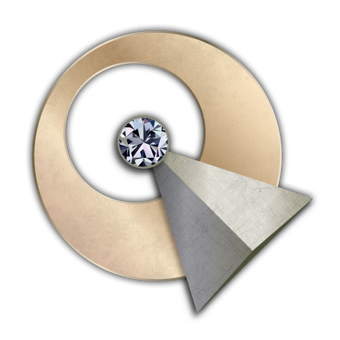 |
| Am I the only one who still believes in this symbol which represents the Vulcan philosophy of IDIC? |
They seem either unwilling or incapable of putting themselves in someone else’s shoes and understanding that “there but for the grace of G-d go I.” They can’t seem to understand that the circumstances of someone else’s life may not be like their own or that the rules we take for granted as descendants of white Europeans aren’t always the same for other ethnic groups or people of color.
It’s enough to make me want to grab them by the collar and shake some sense into them.
Yet at the same time, I know that these friends would have my back in a heartbeat if I ever needed them or got into any serious trouble.
Even my own parents who raised me to be open-minded and see things from other people’s point of view, seem to have become exceptionally narrow minded.
Now I’m no “lefty-snowflake.” I have a long and proud history of being a fence-sitter, whose preferred drink is Grape Nehi (It’s purple). I think both conservatives and liberals have valid concerns and that what is best for our country is a mixture of both their ideas in moderation and not some hardline, unbending adherence to a single political doctrine.
Everyone now seems so entrenched in their view and convinced that only they are right, that they can’t see what would be blatantly obvious to that alien outsider suddenly plunked down in the middle of us. That outsider would be astounded by the hypocrisy as they listened to people forgive or overlook unethical, immoral and in some cases criminal behavior by their own side’s leaders while condemning the other side’s leaders if they’d done the same thing.
But what I find most disturbing is that people not only seem to be willfully bind to our own history, but hell-bent on repeating it.
It’s clear to anyone with even a cursory understanding of world history that we are repeating the mistakes of the past.
Democracies across the world are electing populist strongmen who promote simplistic solutions to all our problems then proceed to undermine the very intuitions they claim to love in order to make their country’s great again.
It’s happening almost exactly as it did back in the 1930’s when Fascism swept through Europe in the wake of World War I and Great Depression, yet no one can see it. Supporters of these populists don’t seem to understand that by supporting policies that attempt to ostracize one group of people, that everyone ends up loosing because when the political winds change direction – and they always do – then they will be ones being ostracized and stripped of their rights.
More troubling are the ones who are noticing this swing toward totalitarianism and scapegoating of minorities but seem to be doing everything in their power to shoot themselves in the foot. They are prompting tactics and using slogans that purposely seem designed to frighten or push away any moderate who might be sympathetic to their cause.
Short rallying cries with no context such as “Defund the Police” and mob actions to pull down statues just play into their opponent’s hands that the left is just a bunch of anarchists.
Look, I get it.
I understand the anger out there and know exactly what protesters are saying when they chant things like “defund the police.” But when I have to have a 20-minute conversation with my mother to just try and convince her that that does not mean getting rid all police but using the money we currently give them for other things, then the slogan is self-defeating.
How do I know this?
Because that’s exactly what I thought when I first heard that slogan myself. My exact thoughts were “They can’t be serious! Without police, there would be anarchy!” Fortunately, I reacted like our alien friend might have, and sought clarification instead of just dismissing the protesters out-of-hand.
And that’s my point. If your slogan immediately turns people off, they aren’t going to listen to the nuances or details of your argument. Stop trying to come up with some catchy soundbite and put some real thought behind your words. Because those words DO matter!
{Sigh}
I keep trying to tell myself that I’m not the only one who sees this going on. Yet the more I look around and hear only silence from moderate voices, the more I feel like I’m alone.
Above the fray.
Watching the world teeter on the brink of total disaster and I’m powerless to stop it.
It makes me wish I really was that alien outsider who could climb aboard his spaceship and leave the planet. That way I wouldn’t have to see the people and places I love destroy themselves just to relearn the same harsh lessons of the past.
Sunday, May 31, 2020
A New Post-Covid Normal? I think not.
 |
| Like now, the wearing of masks during the Spanish Flu was strongly encouraged, but it didn't become the "new normal" after that pandemic past. |
As the country moves to reopen after two months of being locked down, I’ve been hearing a lot of talk about what the “New Normal” will be like after the Coronavirus pandemic passes.
I’ve heard people say that the handshake and shopping mall will go the way of the horse and buggy, face masks, the constant wiping down of surfaces and handwashing will be de rigueur, people will work from home instead of commuting to crowded offices and virtual meetings will replace the in-person kind.
I’ve even herd it suggested that people will be reluctant to gather in large groups anymore.
All this makes me want to role my eyes and ask these folks what box of Cracker Jacks they got their degrees from, because all these pontifications just show how woefully ignorant they are about both human nature and our own history.
To me, these folks are no better than the “Internet Experts” I wrote about last month, who, after five minutes of googling something, suddenly think they know more about any given subject than someone who has devoted his or her career to studying that subject.
Apparently these folks haven’t been paying attention to the newscasts they’ve been on, because I don’t know how else they could have missed all the stories about anti-lockdown protests. They may have started in Michigan and Pennsylvania in April, but they have now spread around the world to places like London, Germany and even Australia.
This just goes to show that we humans are creatures of habit and want to always return to doing something familiar no matter what.
Sure, on the face of it, these pundits’ post-Covid predictions make sense. Let’s face it, handshakes aren’t exactly the most sanitary of customs and crowding together in confined areas like theaters, malls, and sport stadiums or packing ourselves like sardines into airplanes and subway cars are the perfect mediums to spread a contagion. Logically if we wanted to avoid another pandemic – whether it’s the predicted second wave of Coronavirus – or some new and more devastating disease, we should stop doing these things right away.
 |
This clip from the Jan. 21 1919 edition of the Long Beach
Daily Telegram shows that even during the Spanish Flu
pandemic, that people were protesting wearing masks.
(Photo courtesy of Newspapers.com)
|
To paraphrase my favorite observer of human nature, “Star Trek’s” Mr. Spock, we humans aren’t logical. We are governed by our emotions and as recent political discourse in this country shows, we are no longer swayed by rational, logical arguments. We now appear only to respond to appeals to baser instincts.
The type of changes suggested by these “new-normallers” are a radical departure from our pre-Covid world and radical changes seldom result from one, large, single event. Those type of societal changes develop slowly over a course of years. And when there is a sudden shock to the status quo, any changes that do occur are often short-lived.
Don’t believe me?
Then let’s take a look at recent history.
The 911 attacks back in 2001 resulted in a dramatic re-evaluation of transportation security. In the weeks and months that followed, strict new security measures were put in place to prevent terrorists from boarding airplanes or sneaking weapons aboard them. Anyone travelling by air was closely scrutinized with few if any exceptions.
However, as time has gone on without any new attacks, those rules have gradually become more and more relaxed.
Sure, things haven’t returned to 1990s-levels of security, but now frequent flyers can sign up for a program that lets them bypass most of this enhanced security and in someplaces you don’t even have to take off your shoes anymore.
I know in part some of this is due to better technology like full-body scanners and bomb-sniffing baggage checking machines, but I feel like the real reason the restrictions were relaxed was because of the inconvenience factor. Flyers started to complain about how the delays caused by the new security measures were affecting their routines and the airlines, anxious to return to business as normal, were more than happy to accommodate them and pressure the government to relax security.
Still need convincing?
Let’s stay with our airline security example bit longer as we travel a further back in time to the early 1970s.
During that time there was a spike in "skyjackings" and for the first time ever, the government mandated that all baggage needed to be checked and people had to pass through metal detectors before boarding a flight. They also started to place sky marshals on what seemed like every single flight to deter would-be highjackers.
Even as a kid, I remember hearing how seriously everyone was taking these new security measures and how strict they were going to be. We were promised that they would put an end to highjackings once and for all.
And for a while it did.
By the late ’70s and early ’80s, skyjackings were a dim memory. The security had worked.
Then we got complacent. The extra security seemed unneeded, the cost of placing sky marshals on so many flights became unmanageable and while there were still baggage checks and x-rays at the airport, they were treated more like a formality than an actual security check.
 |
After the Spanish Flu, people once again packed together in New York City unbothered
by their close proximity as this photo from 1921 shows. The crowd had gathered
outside the New York Times building to follow the progress of the Jack Dempsey– Georges Carpentier fight in 1921. (Photo courtesy of The New York Times Photo Archive) |
This perfectly illustrates my point.
As memory of a crisis fades – and they all do—even the most vigilant among us revert back to doing things the way we’ve always done them. It is just human nature.
Changing the way a society operates is a hard, slow and incremental process. Even the smartphone revolution took almost a decade to change how we live our day-to-day lives. It only seems like it happened overnight. But in reality, it took that long for the marketing departments of Apple (iPhone), Research in Motion (Blackberry) and Motorola (Android phones) to convince us that we all needed to carry one of their devices. Even the notoriously anti-cell phone, Mrs. BlueScream grudgingly caved in and got one three years ago so she could function in the world.
Now, before you say attitudes towards airline security and smart phones are completely different from pandemics, let me draw your attention back to the Spanish Flu outbreak of 1918-19, to which our current situation has rightfully been compared.
A tad over 100 years ago, our nation was confronted with the same issues we are today. A mysterious new virus was sweeping through the country killing thousands and all the government could do to control the infection rate was to impose isolation and quarantine on the public.
Yes, virology was in its infancy and “wonder drugs” like penicillin were still a decade away, but we still understood the basic science behind it. We knew how the diseases like the flu spread. And yet by 1920-21, the world had returned to normal and people were back to gathering in large numbers in cities, went back to shopping, went back out to restaurants and gathering with friends and family just as they’d done before the pandemic.
It is a trend that continued straight from the 1920s right up to when the lockdowns began little over two months ago.
So why does anyone really expect anything to be different this time around?
As I said in my recent blog about history repeating itself, the past is indeed prologue and to expect a different outcome this time around not only defies logic, but shows an utter disregard and knowledge of our own history.
Thursday, April 30, 2020
Science Friction

It’s a troubling thought, especially coming from someone who spent the first part of his career as a journalist, defending that cherished right.
But to paraphrase comic book legend Stan Lee, “with great freedom comes great responsibility” and lately I see people exercising their right to the former with no regard to the later.
This is hardly a new phenomenon. It has been going on since man first invented language and unfortunately will continue until our race is extinct.
And the way things are going lately, I fear that extinction may be right around the corner.
This pessimism isn’t born of the Coronavirus pandemic that’s currently sweeping the globe. It’s only the latest symptom of it.
My pessimism comes from the fact that we’ve lost trust in science and that people think that they know more about any given subject after 10 minutes on Google, than the scientists, doctors and engineers who’ve spent the better parts of their lives studying it.
 It’s about politicians and fossil-fuel-industry executives denying climate change when the evidence that it is happening is right in front of their faces. They’ll claim the science is inconclusive even though 97 percent of the world’s scientist say it IS happening.
 Look, if only three people out of 100 say you are not an ass, it’s time to get fitted for a saddle, because you ARE an ass. And if you have to begin a sentence with the phrase, “I’m not a scientist, but….” you’re right.
You’re not a scientist.
You don’t know what the hell you’re talking about.
So just SHUT THE FUCK UP!
Yes, I understand that our current way of life is built on the use of fossil fuels and I understand we can’t just get rid of them overnight. But denying a problem exists, doesn’t make it go away. Neither will encouraging people to keeping kicking the problem down the road. Eventually the problem will catch up to us and just because you may not be around to pay that price, your children or grandchildren will. So if you care about them, you need to start doing something now.
It’s also about the Anti Vaxxers, who after reading some discredited medical studies or conspiracy theories on the Internet, think they know more about diseases than doctors who have spent their lives actually fighting and treating them. They will disregard the effectiveness of these drugs focusing on the very small percentage who’ve had some pretty bad reactions to them.
I get it that vaccines aren’t 100 percent effective. But nothing in life is guaranteed. And by advocating that others should follow their misguided lead, Anti Vaxxers are hurting the rest of humanity by reducing our heard immunity and leaving us more prone to pandemic outbreaks.
Look, I’m not saying that Anti Vaxxers are responsible for the Covid-19 crisis.
Far from it.
There is absolutely no evidence that herd immunity would have protected us from the Coronavirus.
What I’m railing about is people blatantly disregarding doctors and scientists’ advice about social distancing, wearing masks and or taking other common sense efforts to keep the disease from spreading just because they want a haircut; think it’s a hoax perpetrated by the “left” and the liberal media or think that it can be “cured” by injecting bleach ; exposing the human body to heat and light and promoting an unproven drugs as a coronavirus 'miracle cures.'
Again, Mr. President – and all you who think like him – if you have to begin a sentence with “I’m not a doctor. But…” just shut up and let actual doctors do the talking!
I get it that the president as well as many in the general public are concerned about the economy. I know they want get back to work ASAP so they don’t lose their livelihoods. But by disregarding the advice of experts, we can make things much, much worse. You can’t have a thriving economy if half the world is dead.
It didn’t work for Thanos, and it won’t work for you.
So instead of using your freedom of speech to sow disbelief in science and scientists, how about encouraging people to actually believe in the ingenuity and creativity of these folks? If scientists, doctors and engineers could get us to the moon and back in just ten years, I have no doubt they can figure out Covid-19 and other issues plaguing our society, too.
Yes, scientists will undoubtedly make mistakes along the way, and we need to expect that. But that’s how we learn. By experimentation, collecting data and basing new theories and experiments on that data – not by basing our findings on the way we wish things to be.
All this takes time and a lot of effort. So unless YOU are willing to put in all the work needed to get a degree in your scientific field of choice, put down your damn smartphone and stop telling people you’re an expert because you read some random article on the Internet, and let the people who ARE experts get on with their work!
Saturday, March 28, 2020
It’s like Déjà vu all over again

We’re living in strange times.
I hear people saying this a lot lately with all the shelter-in-place orders, toilet paper/hand sanitizer/face mask shortages and social distancing. But the writer and obsessive geek in me wonders if that’s really so.
With all due apologies to baseball hall-of-famer and master of malapropisms, Yogi Berra, I can’t help think that this is all just “Déjà vu all over again.”
The spread of the Coronavirus pandemic across the globe sounds like the beginning of every zombie apocalypse/doomsday trope common in to dystopian sci-fi stores and Steven King-esque tales of horror. So naturally the writer part of my brain began to look at our current situation this way. And while obsessing over the details of the plot like any sci-fi fan nitpicking a Hollywood attempt to adapt their favorite book or comic, I began to notice a lot of disturbing similarities to events in our recent past.
Okay, I realize I’m not exactly the first person to point out how the spread of Covid-19 eerily echoes the Spanish Flu pandemic that infected one-third of the world’s population almost exactly 100 years ago. But what I think I am the first to point out is how this incident is just the latest in a series of events that also have direct parallels to things going on at the beginning of 20th century.
So, listen up while I finally put that college history minor of mine to use:

Now flash forward 100 years….
In the year 2000, the world was in the midst of the Tech boom. Companies like Google, Microsoft and Apple were changing the world. Computers were replacing typewriters, ledger books and other analogue methods of keeping records. People began to stop writing letters and started to send e-mails and texts. The spread of the Internet promised to bring the world right to your desktop. Even the way we bought and listened to music, books and other products began to change. This “democratization” of information ushered in another wave of social upheaval and saw the rise of a new breed of robber-barons who were capitalizing on the tech boom: Bill Gates, Steve Jobs, Jeff Bezos, Mark Zucerberg and Larry Page and Sergey Brin.
The early years of the 20th century also saw a huge influx of immigrants to the United States. It’s estimated that more than 15 million arrived on our shores between 1900 and 1915, and with them came the predicable anti-immigrant backlash. It wasn’t uncommon at the time to see racist cartoons in newspapers and magazines targeted at the Irish, Italians, Jews and Chinese.
.jpg?itok=K_xFiGAs) |
| A 1903 cartoon by Louis Dalrymple in Judge magazine depicts Southern European immigrants as rats. (New York Public Library Digital Collection) |
 |
| President Donald Trump speaks during a rally in El Paso, Texas on February 11, 2019. (Joe Raedle/Getty Images) |
fought for the next century, by introducing new tactics, technology and levels of slaughter.
Unfortunately, the same could be said about the War on Terror, which began on September 11, 2001 when a group of Islamic extremists crashed airplanes into the World Trade Center in New York City and the Pentagon in Washington DC.
Like the paradigm shift that occurred in WWI, we’ve had to adapt to a new way of fighting wars. Gone are the days of two (or more) nations slugging it out on some remote battlefield. Today there is no battlefield and the combatants aren’t nation-states, but faceless groups with a vendettas who use everyday objects to inflict death and destruction on unwitting civilian populations. Also like WWI, which introduced the words “tank” and “machine gun” to the modern lexicon, the War on Terror has also introduced new words to our everyday vocabulary: “drone” and “IED.”
Now comes Covid-19 with all its similarities to the Spanish Flu of 1918-19. I can’t help but wonder if the steps we are now taking to slow it’s spread will cause a repeat of another early 20th century event: The stock market crash of 1929 and The Great Depression which followed it.
Then if, as Shakespeare one said, the “past is prologue,” I guess we should expect to see another great conflict on the scale of the second world war.
Hopefully I’m wrong about this, but at the moment, it’s really hard to stop being pessimistic and looking to the past to predict what’s to come in our near future. It’s almost as if Yogi Berra understood this when he uttered those now immortal words: “The future ain’t what it used to be.”