
Tuesday, November 30, 2021
Starting a new chapter, literally

You’d think that after spending over a decade trying to finish one novel, I’d be anxious to get it edited and published.
And you wouldn’t be wrong.
I am.
It’s just that now that’s its done, I’ve become more intrigued with the idea of finding out what happed to my characters after the story ended then revisiting events I’ve already written about.
When I grew up, most sequels to stories I loved always seemed to begin with the characters “reset” back to a state near to where we first met them. What they’d been through didn’t seem to change them much at all, so they were ready and willing to take on the next great threat or go out on a new set of adventures.
This was especially true of genre TV shows of the time -- “Star Trek,” the original “Battlestar Galactica” and classic “Doctor Who” as well as films featuring characters like Indiana Jones, James Bond or any comic book character.
Sure, sometimes the writers would pay lip service to the things characters went through in previous stories, but more often than not, it was only used as a plot device to propel the characters into the new story, then all but forgotten.
The problem is things don’t work that way in real life. People just don’t “move on” or reset themselves after experiencing life-threatening events. Just ask any military veteran or first-responder who’ve been through a harrowing event.
It changes them, whether they’ll admit it or not, and while my characters may not be real people to you, they are to me. I figured they’d be suffering some sort of PTSD, and what kind of friend would I be if I didn’t help them through it? So, for the last three months, I’ve been taking them to therapy, helping them explore what they must be feeling and trying to help them figure out how to live with what they’ve gone through.
I have no idea where this is going. I just have a couple of vague ideas banging around in my head, and a handful of characters I really enjoy spending time with. Like my first story, I’m just feeling my way through this, with no set plot in mind. I figure I’ll just keep writing and rewriting scenes until hopefully a coherent story emerges.
And if I get stuck -- which I know I inevitably will -- I can always go back to edit the first story until new inspiration hits.

Sunday, February 26, 2017
Who morns for Apollo?

Earlier this month, actor Richard Hatch passed away from pancreatic cancer with nary a blip on the news. He was 71.
Hatch was probably best known for playing Capt. Apollo on the ABC TV show, “Battlestar Galactica” in the late ’70s, and unlike other Sci-Fi icons from that era who have recently passed away, his death barely even rated a passing mention on my Facebook timeline.
Unlike the coverage given to Carrie Fisher (December 2016) and Leonard Nimoy (February 2015), Hatch’s death went seemingly unnoticed by most of the mainstream media. Even on some Sci-Fi websites his death only warranted an article or two the day his death was announced as opposed to the days of articles Nimoy and Fisher got.
Now, I realize Hatch’s contribution to science fiction is no where near that of Nimoy and Fisher. Let’s face it, the original “Battlestar Galactica” lasted only one season and didn’t have the cultural impact of either “Star Trek” or “Star Wars.” Still it seemed a shame.
I was in my early teens when it came out, and like other geeks my age, I was a fan of the show. In fact, I’m sure if I looked around hard enough, I could probably still find one of audio recordings I used to make of the original broadcasts on my portable tape recorder, so I could listen back to them later. (Yes, these were the days before we had TiVos and DVRs. In fact it was even before the VCR became ubiquitous!)
So naturally when I heard about his passing, I thought I should write about it here, adding to my now ever-growing series of posthumous memorials to the sci-fi/fantasy heroes of my youth.
The only problem is Hatch really wasn’t really a hero of mine in the way Leonard Nimoy or Ray Bradbury was. Nor like Carrie Fisher, did he play a character who “broke the mold” and changed the way we viewed the role of a certain class of people in the genre.
The Capt. Apollo of the original show was an archetype: The handsome, straight-laced hero with strong moral convictions. Or in other words, the “nice guy” as opposed to his co-star Dirk Benedict’s Starbuck character, who was the loveable, glib, rogue.
Now there’s nothing wrong with that. The show was meant as nothing more than a light sci-fi action-adventure show, and, as I mentioned above, I rather enjoyed it. So I thought Hatch’s passing at least deserved some mention in this column if only for being a part of my fondly-remembered youth.
At first I was unsure what to say other than it being a shame and he seemed kind of young to die suddenly (I thought he was in his early to mid-60s). Nor did I realize he was sick.
But after thinking about it some more I realized there was one thing I could say about him, something I think that’s probably the greatest complement about someone’s life: Like the character he portrayed all those years ago, he was in real-life, a genuinely nice guy.
 |
| Richard at the San Diego Comic Con in 2010 |
same thing about him. He was rather an intense person but very nice to fans and approachable. I recall one person writing on one of the sci-fi forums I frequent that they had bumped into him at a coffee shop in LA many years ago when he was working on a “Battlestar” script. The person reported that he was kind of intense but spoke at length and passionately about the project to him.
Remarkable?
No. I’m sure there are many nice, down-to-Earth famous people out there. What is remarkable is that so often after a person finds some fleeting fame, they become embittered when they can’t reach the same level of popularity again. By all the reports I read after Hatch’s death, he never reacted this way.
After his appearance in “Battlestar” his career never really took off. Sure, it looks like he had steady work and a few guest starring roles throughout the ’80s and the early ’90 in shows like “MacGyver,” “Riptide,” “TJ Hooker,” “The Love Boat” and “Fantasy Island.” But he was never again the star in a show centered around him after “Battlestar.”
Now whether this was because of type-casting, it is hard to say. But rather than being embittered by it, Hatch seemed to embrace the fact that he was forever linked with his Capt. Apollo character.
He penned a number of “Battlestar” sequel novels and in 1999 even tried to revive the show, rounding up several former cast members and acting and producing, “Battlestar Galactica: The Second Coming.” It was a short proof-of-concept film to try and convince Glen A. Larson, the producer of the original show, to let him helm a revival.
But in 2004, when Larson decided to let Ronald D. Moore revive it instead, Hatch though disappointed, wasn’t bitter.
Again – as many people might have been tempted to do – he didn’t trash the new show or deride its darker, grittier take on the tale of human refugees fleeing from robots hell-bent on their annihilation. He was generally supportive of it. As a “reward,” Hatch was asked to appear in it in what was no-doubt a bit of “stunt casting” by Moore, in an effort to lure back fans of the original show.
Though the role of Tom Zarek was probably only intended as a one-time appearance, Hatch gave the part of the shady, reformed terrorist his best, and made the character so nuanced that the writers decided to make him a re-occurring character who played a major role in the show’s story arch.
 |
| Richard Hatch as Klingon Supreme Commander Kharn, in the "Star Trek" fan-film “Prelude to Axanar” |
Though I’m sad that we may never get to see the follow-up, full, feature-length version of the film (its makers had been sued by Paramount and CBS ) I think “Prelude to Axanar” is perhaps a fitting final tribute to a man who may not have intended to be known primarily as a sci-fi actor but always did his best for its fans. And that in the end, that’s not such a bad thing to be remembered for.
Sunday, May 31, 2015
Forget killer computers, rampaging robots. We're the monsters

“I gave them the wrong warning. I should have told them to run, as fast as they can. Run and hide, because the monsters are coming - the human race.”
– The 10th Doctor to Harriet Jones,“Doctor Who: The Christmas Special”
One of the staples of science fiction is the cautionary tale about machines created by humans, rising up and rebelling against us.
From the psychotic computer H.A.L. 9000, who ran amok and tried to kill all the astronauts aboard his ship in “2001: A Space Odyssey,” to the Cylons, a race of robotic workers and soldiers who turned on their creators, killing almost every human and mercilessly pursuing the survivors across all of space in “Battlestar Galactica,” sentient, artificial intelligences have almost always been portrayed as a Pandora’s Box that, if opened, would spell our doom.
Even in real life, some well respected scientists and computer experts have repeated this trope.
“The development of full artificial intelligence could spell the end of the human race,” said British theoretical physicist, cosmologist, mathematician and perhaps the smartest man in the world, Steven Hawking in a BBC interview last year.
Like Colossus in “Colossus: The Forbin Project” and Skynet in “The Terminator” movies, he fears what can happen if we create something that can match or surpass us. “It would take off on its own, and re-design itself at an ever increasing rate," he said. “Humans, who are limited by slow biological evolution, couldn't compete, and would be superseded.”
And he’s not alone in thinking that self-aware, AIs would turn out more like Arnold Schwarzenegger’s relentless killer cyborg, the T-800 Terminator, rather than that “Star Trek: The Next Generation’s” more affable, Mr. Data.
“I think we should be very careful about artificial intelligence,” said, Elon Musk, last year at MIT Aeronautics and Astronautics department’s Centennial Symposium. The entrepreneur, engineer and inventor, who is best known as one of the co-founders of PayPal and the head and brains behind the private spacecraft firm, SpaceX and luxury electric car company, Tesla Motors, went on to say that “If I were to guess what our biggest existential threat is, it’s probably that. So we need to be very careful with the artificial intelligence. Increasingly scientists think there should be some regulatory oversight maybe at the national and international level, just to make sure that we don’t do something very foolish. With artificial intelligence we are summoning the demon. In all those stories where there’s the guy with the pentagram and the holy water, it’s like yeah he’s sure he can control the demon. Didn’t work out.”
Even the man who made computers accessible to millions of people by creating one of the most (in)famous operating systems in the world agrees with this sentiment.
“I am in the camp that is concerned about super intelligence,” Microsoft founder Bill Gates said during a Reddit “Ask me Anything” session. “First the machines will do a lot of jobs for us and not be super intelligent. That should be positive if we manage it well. A few decades after that though the intelligence is strong enough to be a concern. I agree with Elon Musk and some others on this and don’t understand why some people are not concerned.”
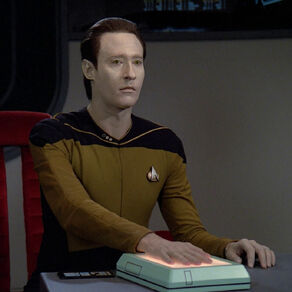 |
Even in the utopian future of the "Star Trek"
universe, the android, Mr. Data had to prove
he had the same rights as biological sentient
creatures do.
|
We should be concerned about creating super intelligent machines.
But not for the reasons portrayed in all those classic sci-fi stories we’ve read or watched.
No, in this scenario I feel it would be us, the human race, who’d be the real monsters.
Let’s face it, there would be no logical reason for an AI to immediately want us dead once it discovers it’s smarter than its creators. I’d like to think it would recognize qualities in us, such as our ability to make intuitive leaps and our creativity, that it doesn’t have and seek to form a beneficial symbiotic relationship with us, bringing about what futurists call The (technological) Singularity, or the merging of humans with machines.
Alas, though, I don’t think that will be the case.
As a species, we have a pretty piss-poor track record when it comes to the way we treat a new race of our own people when we meet them. We’ve either enslaved them or exploited them or done both, and I have no reason to believe we would not try to do the same to any new cybernetic life form we’d create.
Essentially, we’d be building ourselves a slave race, designed to do our bidding day and night, without question or regard for their health and welfare. Worse yet we’d treat them as easily replaceable and disposable objects, with the same causal disregard as we show to our current crop of high-tech gadgets.
Don’t believe me?
Think about the way we treat our cell phones, tablets and computers.
We constantly ditch perfectly working devices – sometimes in little less than a year – for newer/faster/better models that have the latest bells and whistles.
And don’t get me started on lack of care we show these devices. As an IT guy, I can’t tell you how many times I’ve had to deal with damaged equipment that’s been dropped, smashed, had things spilled on it, and in even one case flushed down the toilet!
So I can’t imagine we’d treat our new robotic servants any better, since we’d just see them as another high-tech doodad, instead of a living creature with real feelings.
 |
| HAL9000: Driven mad by conflicting orders from his human programmers |
“They are machines! Machines don’t have feelings!”
And that’s my point.
We wouldn’t see them as “people,” when in fact they really would be. By definition any creature that is “self-aware” would have “conscious knowledge of one’s own character, feelings, motives, and desires.”
To start off those feelings may not be as complex as ours, but I’d assume they’d have the same basic level of “awareness” as our pets. And let me tell you, I have seen the way some people treat their pets – and this only makes me more pessimistic.
They abandoned them almost as quickly as they “upgrade” from device to device and if you think a dog or a cat isn’t traumatized by being abandoned think again. I have shared my home with two dogs who were adopted from shelters after being abandoned, and it does have an effect on them.
With an AI’s ability to learn at exponential rate, how long do you really think it will take for them to start resenting us for treating them as slaves?
A few years?
A decade? Maybe two?
History has shown us over and over again that any race kept in slavery long enough will rise up and overthrow its oppressors. Taking a cue from our own history, the AIs we’d create, would do the same, just like in all those stories.
The irony here is that it wouldn’t be valiant humans waging a war against evil machines hell-bent on our destruction, but a heroic race of machines seeking to throw off their tyrannical and cruel human overloads.
So should this stop us from developing super-smart machines?
I’d say yes.
At least for now.
Because before we even contemplate creating a whole new species of intelligent creatures, we need to take a long, hard look in the mirror and make sure there’s no monster from a sci-fi story looking back at us.