
Wednesday, July 22, 2015
Making it look easy, isn’t easy
 |
| Putting together a good how-to can be just as frustrating as putting together a jigsaw puzzle. |
 |
| “Woodworking for Mere Mortals” |
These often well produced, always entertaining and informative how-to videos which show various projects’ progressions from concept through completion, was the inspiration for last month’s “Giving Old Tech New Life” post.
 |
| Matthias Wandel |
I was confident I could knock the whole thing out in an hour or so.
Boy, was I wrong.
Unlike taking a series of screen shots and writing a captions for them describing what a user needs to click on to proceed to the next step, documenting a build as “simple” as the clock in last month’s blog was a hell of a lot more complex than I’d ever imaged.
 |
| “The Wood Whisperer” |
I never realized the way I work in my shop is drastically different from the way I do things at work.
Almost by definition, working with computers requires approaching things in a logical, orderly fashion; following an exact series of steps in a sequential manner until the task at hand is done. At work, this is exactly how I do things.
But in my shop, I just wing it. I rarely if ever draw any real plans, make a cut list or plot out the order of the build. At most, I have a few crude sketches with dimensions scrawled on them and an idea that I’ve been turning over in my head for a few weeks.
I am well aware that this isn’t the most efficient use of my rather limited time in my shop. I know that if I actually spent some time to create a set of detailed plans in Sketch-Up or even Quark Xpress, I’d be able to avoid the slowdowns that always seem to crop up because I hadn’t foreseen some problem or another when I had “built” the project in my head.
 |
| “Think Woodworks” |
Yet even if I had made detailed plans and followed them to the letter, the clock build still would have taken me twice as long to complete as would have if I wasn’t documenting it. After every step, I had to remember to stop and try to get clear, in-focus pictures that showed what I was doing.
Once that was done I thought I was home-free. All that remained was to write a short introduction and 20 or so captions for the photos, then post it on the blog. I was sure I could accomplish all that in an hour.
Yeah, right…
 |
| Frank Makes” |
“Cool!” I thought. “Everything’s going to plan for once.”
I should have realized right then and there that things wouldn’t be quite that easy.
Instead of the five minutes I’d thought it take me to upload the photos, cut and paste some text and write some simple HTML to get everything looking the way I wanted, it took me over three bloody hours!
I freely admit I’m no IT genius. I’m a generalist who has a very broad understanding of all the various specialties that make up the Information Technology field, and while none of that knowledge runs really deep, I sure as hell know how to create a basic HTML table!!
 |
| Jimmy Diresta |
My coding skills won’t win any awards, and I know the use of tables to format a webpage went out of style with Netscape Navigator back in the late ’90s, but hey, it’s a quick, down and dirty way to do it.
So why the hell Blogspot constantly kept rewriting my code and completely screwing it up is beyond me!
Hey Google. Leave my #%$@! HTML code alone, damn it!
I could have built my own web server from spare parts, bought and registered my own domain and created an entire web site from scratch using only Notepad in the time it took me to get Blogspot to format my last post correctly! (Yes, I know there are third party slideshow plug-ins I could have used, but I mistakenly thought it would be quicker to build my own table rather than learning how to use one of those.)
 |
| April “Wilkerdos” Wilkerson |
So to all of them I say a hearty thank you for keeping me inspired, making me want to get back into my shop and for helping me to wind down at the end of each week.
And if you’ve never check out any of their channels before, please do. Maybe they’ll inspire you too.

Tuesday, June 30, 2015
Giving old tech a new life
But lately my home office has become so cluttered that even Oscar Madison would be appalled at the mess. So I spent a day going through all the old parts I’ve kept around to fix broken computers and weeded out anything more than a few years old.
Those really old parts were a significant portion of my stash, and as I looked at them stacked on my office floor, I couldn’t quite bring myself to just put it all in the trash.
So I decided to give some of those parts new life out in my workshop. The following pictures detail the process I used to turn an old IDE controller card and a broken hard drive into a desk clock.
| 1. I started with a platter from an dead hard drive, an IDE controller card and clock motor. Then gathered some tools: a hot glue gun, a pair of needle-nose pliers and a few other things, like calipers, a hacksaw and drill which aren't pictured here. | 
|
| 2. Using the needle-nose pliers, I removed some of the capacitors on the IDE card. They were in the way of where the clock face was going to go. I didn't feel like going through the trouble of desoldering them, so I just pulled them off, brute-force style. |
 |
| 3. Next I positioned the platter from the old hard drive on the IDE card and marked the center where the spindle for the clock motor needed to come through. |  |
| 4. I took a pair of calipers and measured the thickness of the clock spindle. It was 3/8". |  |
| 5. So I loaded a 3/8" drill bit into my drill press... |  |
| 6. ... and positioned the bit over the mark I made on the card ... |  |
| 7. ... and drilled a hole in it. The drill bit I used was old and not that sharp -- because I didn't want to ruin one I use for my "real" woodworking projects -- but it cut through that card with surprising ease. |  |
| 8. I checked the fit of the clock spindle and once I saw it fit perfectly, I hot glued it to the back of the card. |  |
| 9. Next I took an O ring that came from the dead hard drive and placed it on the card. I needed this to hold the platter of the hard drive off the card, so the "clock face" would clear that big chip you see pictured at right. Since that O-ring overlapped that chip too, I marked the portion I needed to trim away... |  |
| 10. ... and using a mini-hack saw, I cut it away. |  |
| 11. Once cut to fit, I hot glued that to the face of the IDE card. |
|
| 12. I then clamped the card to my work bench so I could remove the little hook on the bracket that secured the card to the computer case. The metal wasn't that thick, but it still took significant effort to cut through it. There's got to be a better way to do this safely with a power tool! |  |
| 13. All that work just to get rid of that little hook! |  |
| 14. And because I'm a perfectionist, I just had to square up the other end of that bracket. That took another few minutes.... |  |
| 15. After that it was back to the drill press to punch holes in that metal bracket so I could screw it to a wood base. I used a newer bit here with a squirt or two of WD40 for lubrication and the bit punched right though the thin metal fine. |  |
| 16. Back at my workbench, I hot glued the platter onto the O ring then used the ring that secured the platter to the spindle of the hard drive's motor to cover the center part of my new clock's face. This too was hot glued down. | 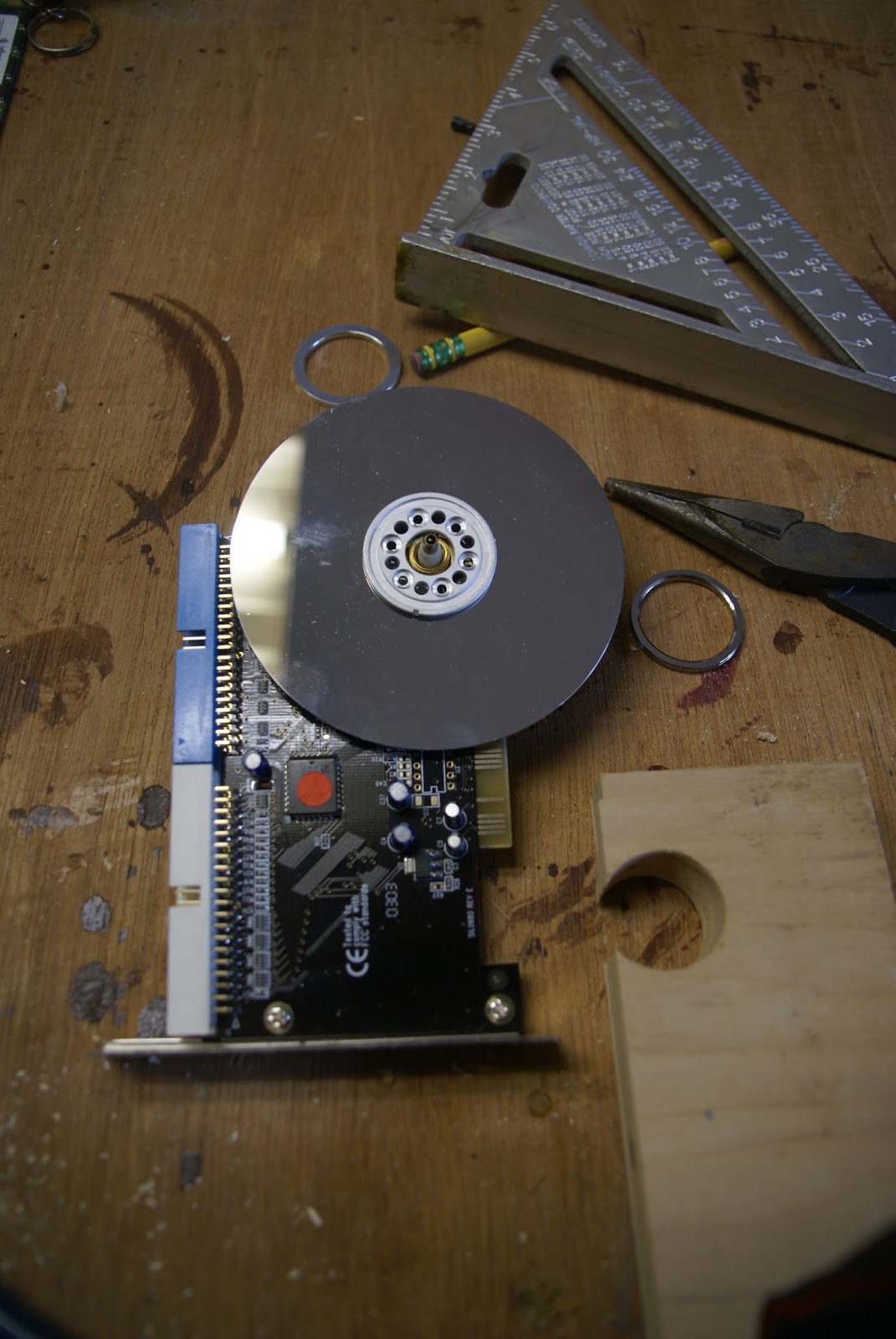 |
| 17. I next attached the clock hands and one of the old IDE ribbon cables to a connector on the side of the clock. | 
|
| 18. One of the things about being a woodworker is that I hardly ever throw away a scrap piece of wood, because, like most woodworkers, we never know when it might come in handy. Well this old test drawer front I made for a project several years ago was just about the perfect size for the clock base. Just needed to be trimmed down a bit on my chop saw. (I could have certainly used a handsaw for this, but my chop saw was right next to my bench and far faster...) After cutting it, I did have to use my router add the fancy profile to the side I cut. For some reason I forgot to photograph that setup, so you're just going to have to take my word for it! |  |
| 19. With the base on my bench I marked out where I wanted the bracket to go on it. |  |
| 20. Then I placed the clock on the base and figured out where I wanted the ribbon cable to attach. I finally decided on the position you see here. |  |
| 21. To prove to myself I could cut a mortise by hand, I drilled out this slot and cleaned it up with some chisels. It wasn't as hard as I thought it would be, so I think I might do mortises this way in my next big furniture project. |  |
| 22. Here's the ribbon cable "connected" to the base. All that was left was to screw the metal bracket down to the wood. Then it was all done! Haven't decided yet how I'll finish that wood. I have a few ideas though.... | 
|

And finally here it is on the right, sitting next to other clocks I've built out of obsolete computer parts!
Sunday, May 31, 2015
Forget killer computers, rampaging robots. We're the monsters

“I gave them the wrong warning. I should have told them to run, as fast as they can. Run and hide, because the monsters are coming - the human race.”
– The 10th Doctor to Harriet Jones,“Doctor Who: The Christmas Special”
One of the staples of science fiction is the cautionary tale about machines created by humans, rising up and rebelling against us.
From the psychotic computer H.A.L. 9000, who ran amok and tried to kill all the astronauts aboard his ship in “2001: A Space Odyssey,” to the Cylons, a race of robotic workers and soldiers who turned on their creators, killing almost every human and mercilessly pursuing the survivors across all of space in “Battlestar Galactica,” sentient, artificial intelligences have almost always been portrayed as a Pandora’s Box that, if opened, would spell our doom.
Even in real life, some well respected scientists and computer experts have repeated this trope.
“The development of full artificial intelligence could spell the end of the human race,” said British theoretical physicist, cosmologist, mathematician and perhaps the smartest man in the world, Steven Hawking in a BBC interview last year.
Like Colossus in “Colossus: The Forbin Project” and Skynet in “The Terminator” movies, he fears what can happen if we create something that can match or surpass us. “It would take off on its own, and re-design itself at an ever increasing rate," he said. “Humans, who are limited by slow biological evolution, couldn't compete, and would be superseded.”
And he’s not alone in thinking that self-aware, AIs would turn out more like Arnold Schwarzenegger’s relentless killer cyborg, the T-800 Terminator, rather than that “Star Trek: The Next Generation’s” more affable, Mr. Data.
“I think we should be very careful about artificial intelligence,” said, Elon Musk, last year at MIT Aeronautics and Astronautics department’s Centennial Symposium. The entrepreneur, engineer and inventor, who is best known as one of the co-founders of PayPal and the head and brains behind the private spacecraft firm, SpaceX and luxury electric car company, Tesla Motors, went on to say that “If I were to guess what our biggest existential threat is, it’s probably that. So we need to be very careful with the artificial intelligence. Increasingly scientists think there should be some regulatory oversight maybe at the national and international level, just to make sure that we don’t do something very foolish. With artificial intelligence we are summoning the demon. In all those stories where there’s the guy with the pentagram and the holy water, it’s like yeah he’s sure he can control the demon. Didn’t work out.”
Even the man who made computers accessible to millions of people by creating one of the most (in)famous operating systems in the world agrees with this sentiment.
“I am in the camp that is concerned about super intelligence,” Microsoft founder Bill Gates said during a Reddit “Ask me Anything” session. “First the machines will do a lot of jobs for us and not be super intelligent. That should be positive if we manage it well. A few decades after that though the intelligence is strong enough to be a concern. I agree with Elon Musk and some others on this and don’t understand why some people are not concerned.”
 |
Even in the utopian future of the "Star Trek"
universe, the android, Mr. Data had to prove
he had the same rights as biological sentient
creatures do.
|
We should be concerned about creating super intelligent machines.
But not for the reasons portrayed in all those classic sci-fi stories we’ve read or watched.
No, in this scenario I feel it would be us, the human race, who’d be the real monsters.
Let’s face it, there would be no logical reason for an AI to immediately want us dead once it discovers it’s smarter than its creators. I’d like to think it would recognize qualities in us, such as our ability to make intuitive leaps and our creativity, that it doesn’t have and seek to form a beneficial symbiotic relationship with us, bringing about what futurists call The (technological) Singularity, or the merging of humans with machines.
Alas, though, I don’t think that will be the case.
As a species, we have a pretty piss-poor track record when it comes to the way we treat a new race of our own people when we meet them. We’ve either enslaved them or exploited them or done both, and I have no reason to believe we would not try to do the same to any new cybernetic life form we’d create.
Essentially, we’d be building ourselves a slave race, designed to do our bidding day and night, without question or regard for their health and welfare. Worse yet we’d treat them as easily replaceable and disposable objects, with the same causal disregard as we show to our current crop of high-tech gadgets.
Don’t believe me?
Think about the way we treat our cell phones, tablets and computers.
We constantly ditch perfectly working devices – sometimes in little less than a year – for newer/faster/better models that have the latest bells and whistles.
And don’t get me started on lack of care we show these devices. As an IT guy, I can’t tell you how many times I’ve had to deal with damaged equipment that’s been dropped, smashed, had things spilled on it, and in even one case flushed down the toilet!
So I can’t imagine we’d treat our new robotic servants any better, since we’d just see them as another high-tech doodad, instead of a living creature with real feelings.
 |
| HAL9000: Driven mad by conflicting orders from his human programmers |
“They are machines! Machines don’t have feelings!”
And that’s my point.
We wouldn’t see them as “people,” when in fact they really would be. By definition any creature that is “self-aware” would have “conscious knowledge of one’s own character, feelings, motives, and desires.”
To start off those feelings may not be as complex as ours, but I’d assume they’d have the same basic level of “awareness” as our pets. And let me tell you, I have seen the way some people treat their pets – and this only makes me more pessimistic.
They abandoned them almost as quickly as they “upgrade” from device to device and if you think a dog or a cat isn’t traumatized by being abandoned think again. I have shared my home with two dogs who were adopted from shelters after being abandoned, and it does have an effect on them.
With an AI’s ability to learn at exponential rate, how long do you really think it will take for them to start resenting us for treating them as slaves?
A few years?
A decade? Maybe two?
History has shown us over and over again that any race kept in slavery long enough will rise up and overthrow its oppressors. Taking a cue from our own history, the AIs we’d create, would do the same, just like in all those stories.
The irony here is that it wouldn’t be valiant humans waging a war against evil machines hell-bent on our destruction, but a heroic race of machines seeking to throw off their tyrannical and cruel human overloads.
So should this stop us from developing super-smart machines?
I’d say yes.
At least for now.
Because before we even contemplate creating a whole new species of intelligent creatures, we need to take a long, hard look in the mirror and make sure there’s no monster from a sci-fi story looking back at us.
Sunday, April 26, 2015
Watch this…
 |
| Without a cell phone the new iWatch is no smarter than a Casio calculator watch from the 1980s. |
“They’re new and innovative and cool!” I gush, but he cuts me off.
“They are wristwatches. We’ve had wristwatches for at least a century.”
“But those are analogue!” I protest.
The elder geek frowns. “Think again, Inspector Gadget,” he says holding up his arm showing me his Casio watch with built-in calculator. “That’s good-old 1980s DIGITAL technology, right there. It tells me the time, has a built-in alarm, a timer and helps me figure out the tip when I go out to eat. What more do you need in a watch?”
 |
When we can make two-way video calls on a
smart
watch without it needing to be tethered
to a cell phone
then maybe Dick and I will
finally upgrade!
|
The elder geek just frowned. “Does it look like I need a fitness tracker?” he asked. “I get all the exercise I need getting up from my computer and walking to the kitchen for a snack.”
“Yeah, well you got me there….” I admit, looking at his pasty figure that would make the Pillsbury Doughboy jealous. “But what about being able to read your texts and e-mails without having to check your phone?”
“How is staring at my wrist anymore convenient or efficient than pulling my phone from its waist holster and glancing down at it?”
“It’s less obvious you’re checking your mail or texts in social situations.”
“So, smart watches give you more of license to be rude. Great. Just what society needs. Another reason to be anti-social. I’ll pass.”
“But what about all the apps you can run on them? Like GPS, weather reports and calendar reminders?”
“You mean I can ditch my phone and just run these from a smart watch?”
“Well, no. No exactly.”
“What do you mean, not exactly?”
“You still need your phone. Smart watches just read data from your phone and use the phone’s wireless or cellular connection to attach to the Internet.”
“So how is that innovative? Without a cell phone you Smart Watch isn’t so smart is it? It’s no better than my trusty 30-year-old Casio.”
“Well, no…. but…but…”
 |
Dick Tracy's watch is STILL more innovative than
today's so-called crop of smart watches! |
“But what really ticks me off about calling these so-called Smart Watches innovative is that NONE of them can do the one thing we’ve all been waiting for since the Dick Tracy comics appeared in the 1930s. Make video calls!
“So until the time comes when these watches can replace my cell phone AND make video calls by themselves, I’ll stick with my trusty old Casio.”
Tuesday, March 31, 2015
Making Internet access a public utility is a Net gain for us all

The recent two winters’ rash of harsh weather and their associated scattered power outages have got me thinking about how much of our 21st-century lifestyle is largely dependant on a late 19th century technology – the electrical grid.
With memories of my five-day trip back to the pre-electrified past – courtesy of Hurricane Sandy – still fresh in mind, I have watched in amazement how the Northeast had to again cope with a series of blackouts brought on by severe winter storms.
As I walked my dog each freezing cold night, I kept looking up at the ice hanging down from the overhead wires wondering why we still run power lines above ground. After more than 100 years of storms, accidents and even sabotage taking down power lines, you’d think that by now we would have come up with a more efficient and less failure-prone way of distributing our power.
But human short-sightedness never ceases to amaze me. Sure it’s expensive to convert overhead lines to an underground distribution system, but electricity is no longer a novelty that just powers a few light bulbs. Unlike our grandparents or great grandparents, we can’t just carry on our lives as usual if the lights go out. We’ve grown dependant on electricity. It powers just about everything in our homes and businesses and when the power goes out, pretty much everything comes to a crashing stop.
This is why companies that produce and distribute electricity are regulated as public utilities. No one argues about the need for this, so I don’t understand all the hullabaloo about ’Net Neutrality.
Just as our modern society can no longer operate without electricity, it’s now getting to the point where our economy won’t be able to function without fair and equal access to high-speed Internet.
Hey, Washington! This ain’t the 1980s anymore! It’s not even the ’90s, where Internet access was a novelty and the domain of geeks like me and a few really forward-looking entrepreneurs. In less than 20 years, it has become so thoroughly integrated into our lives that I bet most people can’t go more than five minutes without tweeting, e-mailing, Googling, or doing something on an Internet connected device. (Go ahead. I dare you to try to see how long you can go without the Internet. I’ll wait….)
I’d even be willing to bet that at least half of our economy is somehow dependant on Internet access. And that’s only likely to grow in the future. So yes, Internet access absolutely needs to be regulated as a public utility.
The case for this couldn’t have been made any clearer after I read this article on gawker.com: Man Forced to Sell His New House Because Comcast Lied to Him
For those who don’t feel like reading the story, it’s a tale about a software engineer who checked with Comcast, one of the county’s biggest Internet Service Providers, too see if they could provide high-speed Internet access to a home he was thinking about purchasing. After repeatedly checking with them and getting their assurance they could, this software engineer, who makes his living from home, bought the house. Then after three months of trying to get Comcast to come out and hook him up, the company basically told him, they can’t service that area and never could. He even volunteered to pay someone to lay a cable from Comcast’s nearest connection point to his house – at a cost to him of around $56,000 and $60,000 – and Comcast still refused.
The point of this story is not how bad Comcast’s customer service is – just about anyone familiar with the company already knows it – it’s that this incident could have been avoided if Comcast and other ISPs were regulated like the electrical companies.
By law, public utilities must report to the government exactly where their power, gas and/or water lines are. Had Comcast been forced to report the location of their lines, this poor software engineer could have called 811, gone online to www.call811.com, or even checked with the local municipality’s call before you dig program and found out that Comcast’s line stopped some 2,500 feet from his house.
Now you may be thinking most people don’t work from home, and this is not a problem that’s going to affect many people. And you’re right – for now.
But more and more of us are beginning to have the ability to work from home. With the advent of cell phones, tablets and laptops, the workforce is becoming increasingly mobile, and employers are beginning to take notice.
Mine certainly has.
As I stated up top, the last two winters here in the Northeast have been kind of brutal. But during these recent snow emergencies, I was able to work as just as efficiently from home as I could have from my office – all without having to get into my car and risk life and limb trying to get to in, like I had to do so often in the past.
And it wasn’t just our IT staff that had that advantage. Many people in our accounting and sales departments were able to do the same thing, as were our reporters. The upshot is we got our paper out the door and posted online just as if it were any other day.
I suspect many people at other companies in my area had the same experience these past two winters. None of this would have been possible if some company like Comcast or Verizon or Time Warner had put us in some Internet slow lane.
So don’t you believe it when they tell you regulating them as a utility and forcing all Internet traffic to move at the same speed will stifle innovation.
Without Internet fast lines, web developers still figured out a way for folks to share files and videos online, create successful on-demand streaming movie sites which effectively put the neighborhood video rental store out of business, and create cloud services where we can quickly backup and store gigabytes-worth of our personal data.
In fact, it’s more than likely that had we had the premium-priced “fast lanes” that ISPs want, companies like Youtube, Netflix, Hulu, Dropbox and Carbonite would have died while still startups, because they wouldn’t have been able to afford access to the “fast lane” that made their services possible.
In fact if it’s anyone who wants to stifle innovation, it’s the big ISPs like Comcast, Verizon and Time-Warner. They’ve become fat and lazy from their virtual monopolies and are now panicking at the thought that a tiny startup could upset their apple-carts and do to them what Netflix, Amazon Prime and Hulu did to the Blockbuster and Suncoast video store chains.
So don’t let the big ISPs turn out the lights on future innovators. The power to stop them is in our hands.
Saturday, February 28, 2015
Nimoy's legacy is more than just Mr. Spock
“Accepting death - by understanding that every life comes to an end, when time demands it. Loss of life is to be mourned, but only if the life was wasted.”
-- Spock to his younger self“Yesteryear” Star Trek – The Animated Series
 |
| Leonard Simon Nimoy March 26, 1931 – February 27, 2015 |
Childhood heroes hold an unusual place in our psyches.
They are often the first people to spark our fledging
imaginations and inspire us to do something we’d never dreamed of before, even
if all we do is to pretend to be like them at first.
As we grow older and more jaded, these childhood heroes tend
to maintain their place of honor in our personal pantheon of role models even
as other heroes we idolize later in life fall away as we become aware of their
all-to-human flaws and we begin to cynically pick them apart.
So it was with a profound sadness that yesterday I learned
of the death of one of my very earliest childhood heroes – Leonard Nimoy and
his alter ego Mr. Spock.
We never picture our heroes dying, especially those who have
accompanied us so long on our trek through life. We just we assume they will
always be there to inspire us and lift our spirits when we need it. After all
that’s what heroes do.
But now, like that
Robert Frost poem about two paths diverging in the wood, I find I must continue
down my path alone, while my hero takes the path to “the undiscovered country
from whose bourn no traveler returns.”
I mention poetry here because as well as being a talented
actor whose career spanned multiple decades, Nimoy was also an accomplished director (“Three Men and aBaby,” “The Good Mother,” “Vincent” and the third and fourth “Star Trek”
movies); a poet (“A Lifetime of Love: Poems on the Passages of Life,” “Come Be with Me: A Collection of Poems” ,
“Will I Think of You?” )
and a very active member of the Jewish community.
Yet despite his many accomplishments, it seems he will
always be remembered for playing a half human, half alien on a campy sci-fi
television series for three short years in the late ’60s and again in a couple
more times in the ’80s, ’90s and 2000s. But to paraphrase from his obit on NPR,
“instead of being a punchline, Leonard Nimoy gave the role of Mr. Spock
gravitas.”
Like the golem of Jewish folklore, he breathed life into the
role of the starship Enterprise ’s
logical science officer, a role that in a lesser actor’s hands might have come
off as a caricature of robot in a human body. He gave the part a quiet dignity
that convinced this 6 or 7 year-old who watched the show religiously in the
early ’70s that Mr. Spock was as “real” a person as the actor who portrayed
him.
“Star Trek” was my “gateway drug” into the world of science
fiction and for the longest time it was my only drug, mostly because – if you
will excuse the expression – of my fascination with the character of Mr. Spock.
When my friends and I used to play “Star Trek” there would
inevitably be arguments over who would get to be the captain. But I didn’t
care. I never wanted to be James T. Kirk. I always wanted to be the Vulcan science
officer.
And apparently I wasn’t the only one who felt that way.
Talking with my friend Christina soon after we learned of Nimoy’s passing, she
recalled one of the last conversations she had with her grandmother. They were
discussing their favorite “Star Trek” characters, and her grandmother said she
preferred the dashing, swashbuckling Captain Kirk. But Christina told her she
preferred nerdy characters like Mr. Spock.
“What does that say about me?” she asked, laughing.
Well it says she was a lot like a legion of fans who learned
from Nimoy’s portrayal of Mr. Spock, that there was nothing wrong with being
smart – and showing it – and that math and science could be cool.
But perhaps the biggest thing I learned from him, and the
reason he’s always remained my hero, is that he taught me to be comfortable in
my own skin.
Like Spock, who was the only alien among a large crew of
humans, I too felt like an outsider when I was growing up. Until fifth grade, I
lived in Rhode Island
where there weren’t that many Jews, and while the anti-Semitism wasn’t always
overt, I still remember a time I came home to find neighborhood kids had
scrawled swastikas on my family’s garage doors. I also vividly remember being
shunned because I didn’t celebrate the same holidays as the other kids. This
combined with the fact that I was never interested in the same things my peers
were made me feel like I had my face pressed against a window watching other
kids playing in a room I wasn’t allowed in.
But every night, I’d come home, turn on the TV and see Mr.
Spock dealing with the same sense of isolation as I was and watched how he earned
the respect of his crew. Suddenly I no longer felt like I was alone. I had a
role model I could emulate, and if I did, I’d eventually “fit in” and be
accepted.
And he was right. Eventually I found a “crew” of my own who
accepted me as I was and all those people who used to make fun of me for being
into weird and geeky things like computers suddenly need my technical expertise
to fix all their stuff. (Okay, some of those people still may not really accept me; I’ll settle for the cash they shell
over to me for fixing all their high-tech gizmos).
Recently I’ve also come to believe that being the “outsider”
or “observer” wasn’t such a bad thing afterall. I’d like to think it’s
benefited my writing, giving me a keener insight into human nature.
So, for giving me self confidence, a lifelong-love of technology
which I’ve been able to turn into a comfortable career, and for, I hope, making
me a better writer, I thank you Leonard Nimoy. May you go to your rest knowing
that to me and your legions of fans, you won’t be remembered as only Mr.
Spock.
You’ll be remembered for your most import role of all.
As our hero.
Saturday, January 31, 2015
Much to say about nothing…
Usually I try to shine a light on something obscure or share my weird take on things going on in the worlds of technology or geekdom. But this month I’ve got nothing.

Nada.
Bupkis.
Well, that’s not exactly true.
I’ve got a lot of ideas running around my head – like why passwords are passé, what a world without privacy would be like (and would we really notice?) and why today’s geeks don’t seem to have as vivid imaginations as my generation did. (That’s right all you youngsters! Get off my lawn!)
So then, why isn’t this month’s post about one of those ideas?
Well, because at the moment, all they are, are just ideas. Ideas that would take me all of about a paragraph to write.
And that’s not enough to fill this space.
Not, at least, for someone who subscribes to the George RR Martin school of story telling, where “short” stories range about 500 pages.
Now any good journalist will tell you that a well-written article, column or essay should be concise and to the point. They’d tell you to avoid what one of my curmudgeonly J-school professor’s called “The Great American Nose Bleed.” But I think even he would have had a problem with a feature column that was only one or two short paragraphs long.
And yes, before you ask, I was a young and crusading Clark Kent-type before being lured over to what many of my newsroom friends refer to as the “dark side.”

I wouldn’t call what’s happening to me a case of writer’s block. Ideas are still popping into my head at their usual pace. It’s just that none of them have caught my imagination they way they usually do, nor have any taken off and blossomed into something more concrete.
I blame the winter for this.
Flowers don’t blossom in the winter and concrete doesn’t cure correctly in the cold, so it makes sense I’d have trouble writing when I hate the cold.
In fact, when it gets cold here in the Northeast, my motivation to do anything other than curl up under a blanket (or with the dog, if a blanket isn’t handy) and watch TV and sleep drops faster than the mercury in the thermometer outside my window.
For the past month, I’ve been tired, cold and grumpy. Kinda like a bear, who has the right idea about the winter. At the first sign of cold weather, they head for a nice comfy cave, set the alarm clock for spring and sleep in until it’s warmer outside.
Unfortunately, I don’t have that option, though I wouldn’t mind trying to hibernate until spring.
I bet you I could.
It would be nice to finally catch up on my sleep and when I awoke, I’m sure I’d be really motivated by all the strange and new ideas I got during that extended period of dreaming.
Even if that wasn’t the case, I’d at least have a great story about how I slept all winter to tell you about in my next post.
Subscribe to:
Posts (Atom)